Advertisements
Advertisements
प्रश्न
In Δ PQR, s is a point on PR such that ∠ PQS = ∠ RQS . Prove thats is equidistant from PQ and QR.
Advertisements
उत्तर
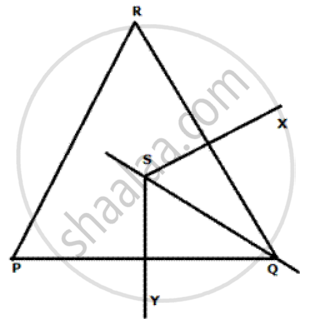
Steps of Construction:
(i) Draw line segment PQ.
(ii) With P and Q as centre draw intersecting arcs at R.
(iii) Join PR and RQ.
(iv) Draw angle bisector of angle Q.
(v) Draw perpendicular bisectors of PQ and RQ which meet the angle bisector at S. S is the required point.
(vi) In Δ QSY and Δ QSX
SQ= SQ
∠ SQY = ∠ SQX
∠ SYQ = ∠ SXQ = 90 degrees.
Therefore, Δ QSY and Δ QSX are congruent.
Hence, SY = SX and therefore S is equidistant from PQ and RQ.
APPEARS IN
संबंधित प्रश्न
Use ruler and compasses only for this question. Draw a circle of radius 4 cm and mark two chords AB and AC of the circle of lengths 6 cm and 5 cm respectively.
(i) Construct the locus of points, inside the circle, that are equidistant from A and C. prove your construction.
(ii) Construct the locus of points, inside the circle that are equidistant from AB and AC.
Draw a straight line AB of 9 cm. Draw the locus of all points which are equidistant from A and B. Prove your statement.
Draw two intersecting lines to include an angle of 30°. Use ruler and compasses to locate points which are equidistant from these Iines and also 2 cm away from their point of intersection. How many such points exist?
A and B are fixed points while Pis a moving point, moving in a way that it is always equidistant from A and B. What is the locus of the path traced out by the pcint P?
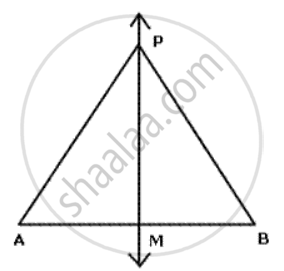
In given figure 1 ABCD is an arrowhead. AB = AD and BC = CD. Prove th at AC produced bisects BD at right angles at the point M
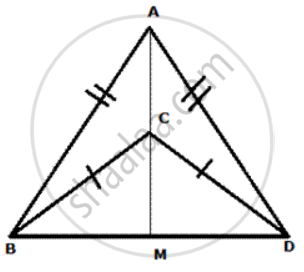
In Δ PQR, bisectors of ∠ PQR and ∠ PRQ meet at I. Prove that I is equidistant from the three sides of the triangle , and PI bisects ∠ QPR .
Draw and describe the lorus in the following cases:
The Iocus of the mid-points of all parallel chords of a circle.
Describe completely the locus of a point in the following case:
Centre of a circle of varying radius and touching the two arms of ∠ ABC.
Draw and describe the locus in the following case:
The locus of a point in the rhombus ABCD which is equidistant from the point A and C.
State and draw the locus of a point equidistant from two given parallel lines.
