Advertisements
Advertisements
प्रश्न
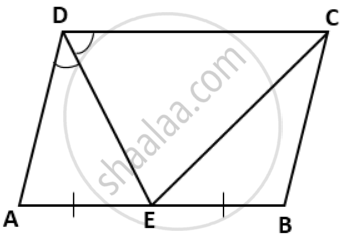
In a parallelogram ABCD, E is the midpoint of AB and DE bisects angle D. Prove that:CE is the bisector of angle C and angle DEC is a right angle
Advertisements
उत्तर

Since BC = BE
⇒ ∠BEC = ∠BCE ...(Angles opposite to equal sides are equal)
∠BEC = ∠ECD ...(Alternate angles)
⇒ ∠BCE = ∠ECD
⇒ CE is the bisector of ∠C ....(proved)
∠DCE = `(1)/(2)∠"C"` ...(Given CE bisects ∠D)
∠CDE = `(1)/(2)∠"D"` ...(Given DE bisects ∠D)
∠DCE + ∠CDE
= `(1)/(2)(∠"C" + ∠"D")`
= `(1)/(2) xx 180°` = 90°
Thus, in ΔDCE,
∠DEC = 180° - ∠DCE + ∠CDE = 180° - 90°
⇒ ∠DEC = 90°.
APPEARS IN
संबंधित प्रश्न
The diagonal BD of a parallelogram ABCD bisects angles B and D. Prove that ABCD is a rhombus.
In the alongside diagram, ABCD is a parallelogram in which AP bisects angle A and BQ bisects angle B.

Prove that:
- AQ = BP
- PQ = CD
- ABPQ is a parallelogram.
In the given figure, ABCD is a parallelogram.
Prove that: AB = 2 BC.

In parallelogram ABCD, the bisector of angle A meets DC at P and AB = 2 AD.
Prove that:
(i) BP bisects angle B.
(ii) Angle APB = 90o.
ABCD is a parallelogram. The bisector of ∠BAD meets DC at P, and AD is half of AB.
Prove that: ∠APB is a right angle.
In a parallelogram ABCD, E is the midpoint of AB and DE bisects angle D. Prove that: BC = BE.
In the given figure, the perimeter of parallelogram PQRS is 42 cm. Find the lengths of PQ and PS.
Find the perimeter of the parallelogram PQRS.

In parallelogram ABCD of the accompanying diagram, line DP is drawn bisecting BC at N and meeting AB (extended) at P. From vertex C, line CQ is drawn bisecting side AD at M and meeting AB (extended) at Q. Lines DP and CQ meet at O. Show that the area of triangle QPO is `9/8` of the area of the parallelogram ABCD
Which of the following statement is correct?