Advertisements
Advertisements
प्रश्न
The alongside figure shows a parallelogram ABCD in which AE = EF = FC.
Prove that:
- DE is parallel to FB
- DE = FB
- DEBF is a parallelogram.

Advertisements
उत्तर
Construction:
Join DF and EB
Join diagonal BD
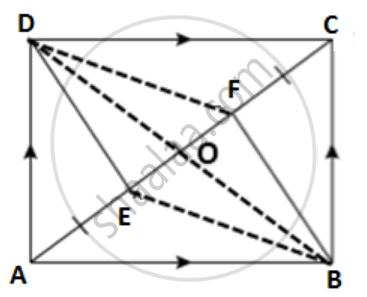
Since diagonals of a parallelogram bisect each other.
∴ OA = OC and OB = OD
Also, AE = EF = FC
Now, OA = OC and AE = FC
⇒ OA - AE = OC - FC
⇒ OE = OF
Thus, in quadrilatreal DEFB, bisect each other.
OB = OD and OE = OF
⇒ Diagonals of a quadrilateral DEFB bisect each other.
⇒ DEFB is a parallelogram.
⇒ DE is parallel to FB
⇒ DE = FB ...(Opposite sides are equal)
APPEARS IN
संबंधित प्रश्न
In the alongside diagram, ABCD is a parallelogram in which AP bisects angle A and BQ bisects angle B.

Prove that:
- AQ = BP
- PQ = CD
- ABPQ is a parallelogram.
In the given figure, ABCD is a parallelogram.
Prove that: AB = 2 BC.

The following figure shows a trapezium ABCD in which AB is parallel to DC and AD = BC. 
Prove that:
(i) ∠DAB = ∠CBA
(ii) ∠ADC = ∠BCD
(iii) AC = BD
(iv) OA = OB and OC = OD.
In parallelogram ABCD, the bisector of angle A meets DC at P and AB = 2 AD.
Prove that:
(i) BP bisects angle B.
(ii) Angle APB = 90o.
PQRS is a parallelogram. T is the mid-point of PQ and ST bisects ∠PSR.
Prove that: QR = QT
PQRS is a parallelogram. T is the mid-point of PQ and ST bisects ∠PSR.
Prove that: ∠RTS = 90°
ABCD is a parallelogram. The bisector of ∠BAD meets DC at P, and AD is half of AB.
Prove that: BP bisects ∠ABC.
In a parallelogram ABCD, E is the midpoint of AB and DE bisects angle D. Prove that: BC = BE.
In the given figure, the perimeter of parallelogram PQRS is 42 cm. Find the lengths of PQ and PS.
In the following figure, it is given that BDEF and FDCE are parallelograms. Can you say that BD = CD? Why or why not?

