Advertisements
Advertisements
प्रश्न
If x = h + a cos θ, y = k + b sin θ.
Prove that `((x - h)/a)^2 + ((y - k)/b)^2 = 1`.
Advertisements
उत्तर
Given: x = h + a cos θ
x − h = a cos θ ...(i)
y = k + b sin θ
y − k = b sin θ ...(ii)
The given equation is
`((x - h)/a)^2 + ((y - k)/(b))^2 = 1`
LHS = `((a cos θ)/a)^2 + ((b sin θ)/b)^2 ` ...[Putting the values of (i) and (ii)]
= cos2θ + sin2θ
= 1
= RHS
Hence proved.
APPEARS IN
संबंधित प्रश्न
Prove the following identities:
`(1 + sin A)/(1 - sin A) = (cosec A + 1)/(cosec A - 1)`
`(1+tan^2theta)(1+cot^2 theta)=1/((sin^2 theta- sin^4theta))`
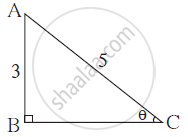
From the figure find the value of sinθ.
Write the value of cosec2 (90° − θ) − tan2 θ.
Write the value of \[\cot^2 \theta - \frac{1}{\sin^2 \theta}\]
Prove the following identity :
`(tanθ + secθ - 1)/(tanθ - secθ + 1) = (1 + sinθ)/(cosθ)`
Prove the following identities:
`(sec"A"-1)/(sec"A"+1)=(sin"A"/(1+cos"A"))^2`
Without using the trigonometric table, prove that
cos 1°cos 2°cos 3° ....cos 180° = 0.
Prove the following identities.
`sqrt((1 + sin theta)/(1 - sin theta)) + sqrt((1 - sin theta)/(1 + sin theta))` = 2 sec θ
cos θ . sec θ = ?
