Advertisements
Advertisements
प्रश्न
If ∆ABC is a right triangle and if ∠A = `pi/2` then prove that sin2 B + sin2 C = 1
Advertisements
उत्तर
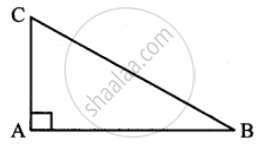
From diagram,
sin B = `"AC"/"BC"`, sin C = `"AB"/"BC"
L.H.S = sin2 B + sin2 C
= `"AC"^2/"BC"^2 + "AB"^2/"BC"^2`
= `("AC"^2 + "AB"^2)/"BC"^2`
= `"BC"^2/"BC"^2`
= 1
= R.H.S
APPEARS IN
संबंधित प्रश्न
Find the value of the trigonometric functions for the following:
cos θ = `- 1/2`, θ lies in the III quadrant
Find the value of the trigonometric functions for the following:
sec θ = `13/5`, θ lies in the IV quadrant
Find all the angles between 0° and 360° which satisfy the equation sin2θ = `3/4`
Find the value of tan `(7pi)/12`
If a cos(x + y) = b cos(x − y), show that (a + b) tan x = (a − b) cot y
Prove that sin 105° + cos 105° = cos 45°
Show that tan 75° + cot 75° = 4
Prove that cos(A + B) cos C – cos(B + C) cos A = sin B sin(C – A)
Prove that sin(n + 1) θ sin(n – 1) θ + cos(n + 1) θ cos(n – 1)θ = cos 2θ, n ∈ Z
If cos(α – β) + cos(β – γ) + cos(γ – α) = `- 3/2`, then prove that cos α + cos β + cos γ = sin α + sin β + sin γ = 0
Prove that cot(A + B) = `(cot "A" cot "B" - 1)/(cot "A" + cot "B")`
Find the value of tan(α + β), given that cot α = `1/2`, α ∈ `(pi, (3pi)/2)` and sec β = `- 5/3` β ∈ `(pi/2, pi)`
If θ + Φ = α and tan θ = k tan Φ, then prove that sin(θ – Φ) = `("k" - 1)/("k" + 1)` sin α
Find the value of cos 2A, A lies in the first quadrant, when cos A = `15/17`
Find the value of cos 2A, A lies in the first quadrant, when sin A = `4/5`
If cos θ = `1/2 ("a" + 1/"a")`, show that cos 3θ = `1/2 ("a"^3 + 1/"a"^3)`
Prove that `32(sqrt(3)) sin pi/48 cos pi/48 cos pi/24 cos pi/12 cos pi/6` = 3
Prove that sin x + sin 2x + sin 3x = sin 2x (1 + 2 cos x)
Prove that cos(30° – A) cos(30° + A) + cos(45° – A) cos(45° + A) = `cos 2"A" + 1/4`
If A + B + C = 2s, then prove that sin(s – A) sin(s – B)+ sin s sin(s – C) = sin A sin B
