Advertisements
Advertisements
प्रश्न
If AB + 7C = 102, where B ≠ 0, C ≠ 0, then A + B + C = 14.
विकल्प
True
False
Advertisements
उत्तर
This statement is True.
Explanation:
AB
We have, + 7C
102
Here, B + C is either 2 or a two-digit number whose one’s digit is 2.
If B = C = 1, lf 8 = 5, C = 7, A = 2 and A + B + C = 2 + 5 + 7 = 14
APPEARS IN
संबंधित प्रश्न
If \[\overline{{3x2}}\] is a multiple of 11, where x is a digit, what is the value of x?
Which of the following statement is true?
If a number is divisible by 4, it must be divisible by 8.
Do you remember magic triangles? Come now, let s make some magic squares.
- Fill this square using all the numbers from 21 to 29.
Rule: The total of each side is 75.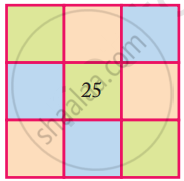
Now you try and change these numbers into special numbers —
28
If B × B = AB, then either A = 2, B = 5 or A = ______, B = ______.
If N ÷ 5 leaves remainder 3 and N ÷ 2 leaves remainder 0, then N ÷ 10 leaves remainder 4.
A five-digit number AABAA is divisible by 33. Write all the numbers of this form.
Find the value of k where 31k2 is divisible by 6.
756x is a multiple of 11, find the value of x.
If 56 × 32y is divisible by 18, find the least value of y.
