Advertisements
Advertisements
प्रश्न
Identify the following diagram, label it and write detail information in your words:

Advertisements
उत्तर
Paramoecium:

- Paramoecium is the organism shown.
- It is a member of the Kingdom Protista. It is a Protista that looks like an animal. Because cilia are used for locomotion, hence referred to as ciliate protozoans.
- On the cell surface, there is a gullet that opens.
- There are two nuclei present, one larger called the macronucleus and one smaller called the micronucleus.
- Osmoregulation is helped by the presence of large contractile vacuoles.
APPEARS IN
संबंधित प्रश्न
Choose the correct option:
Select odd one out for Heterotrophic bacteria.
Choose the correct option:
Paramoecium : Ciliated Protist Plasmodium : ____________
Answer the following:
What are the salient features of monera?
Write short notes:
Useful and harmful bacteria
Write short note:
Five Kingdom system
Draw a neat labelled diagram:
Euglena
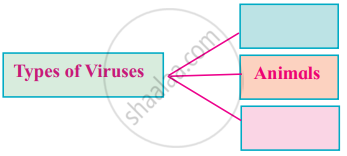
Complete chart and explain in your word: Types of Viruses
Identify the following diagram, label it and write detail information in your words:

Identify the following diagram, label it and write detail information in your words:

The scientific name of the sunflower is given below. Identify the correctly written name.
Match the following:
| Kingdom | Example |
| i. Monera | a. Riccia |
| ii. Protista | b. Cyanobacteria |
| iii. Plantae | c. Rhizopus |
| iv. Fungi | d. Diatoms |
Complete the following:
____________ - Entamoeba
Match List I with List II -
| List-I | List-II |
| A. Rhizopus | I. Mushroom |
| В. Ustilago | II. Smut fungus |
| C. Puccinia | IIΙ. Bread mould |
| D. Agaricus | IV. Rust fungus |
Each of the following characteristics represent a Kingdom proposed by Whittaker. Arrange the following in increasing order of complexity of body organisation.
- Multicellular heterotrophs with cell wall made of chitin.
- Heterotrophs with tissue/organ/organ system level of body organisation.
- Prokaryotes with cell wall made of polysaccharides and amino acids.
- Eukaryotic autotrophs with tissue/organ level of body organisation.
- Eukaryotes with cellular body organisation.
Choose the correct answer from the options given below:
