Advertisements
Advertisements
प्रश्न
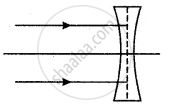
(i) Draw a ray diagram to show how the lens can be used as a ‘magnifying glass’? State the nature of the lens.
(ii) In what respect does the image in (i) above different from the image formed by a concave lens?
Advertisements
उत्तर
(i) The nature of the lens used is convex. The image formed is magnified, virtual, and upright. In this case, a convex lens is said to be used as a ‘magnifying glass.’

(ii) Image formed by a concave lens differs from the image in size. It is much smaller in size.
संबंधित प्रश्न
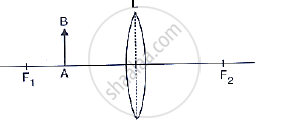
The following diagram shows an object AB and a converging lens L with foci F1 and F2 State three characteristics of the image in relation to the object.
A magnifying glass forms ______.
If the magnification produced by a lens is - 0.5, the correct statement is ______.
The focal length of a convex lens is 25 cm. At what distance from the optical centre of the lens an object be placed to obtain a virtual image of twice the size?
An illuminated object lies at a distance 1.0 m from a screen. A convex lens is used to form the image of the object on a screen placed at a distance of 75 cm from the lens. Find:
- the focal length of the lens, and
- the magnification.
An object is placed at a distance of 20 cm in front of a concave lens of focal length 20 cm. find: the magnification of image.
The magnification by a lens is -3. Name the lens and state how are u and v related?
Define the term magnifying power of a simple microscope. How does it depend on the focal length of the lens used?
Name the lens for which magnification is always less than 1.
Copy and complete the following ray diagram.