Advertisements
Advertisements
प्रश्न
Hydrogen chloride gas is very soluble in water. It is dissolved in water to prepare hydrochloric acid by using an anti-suction device, as shown in the diagram. Very briefly explain how this device prevents the suction of water into the flask, in which hydrogen chloride gas is produced.
Advertisements
उत्तर
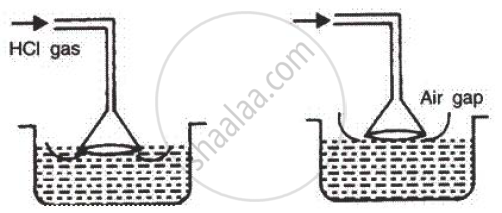
An inverted funnel connected to the HCI gas supply is placed in a beaker in such a way that the rim of the funnel just touches the surface of water in the beaker. HCI gas coming through the delivery tube fills the mouth of the funnel and then dissolves in water. Hence, a low pressure is created and back suction occurs. As a result of it, water level rises in funnel and level of water in the beaker is lowered. Thus, the rim of the funnel loses contact with water and the outside air rushes in through the gap to equalize the pressure on either side of the funnel. The solution falls back into the beaker due to force of gravity.The water level then falls and the funnel drops back to its original position.
APPEARS IN
संबंधित प्रश्न
When dilute HCl is added to a salt Q, a brisk effervescence is produced and the gas turns lime water milky.
When NH4OH solution is added to the above mixture (after adding dilute HCl), it produces a white precipitate which is soluble in excess NH4OH solution.
The aim of the Fountain experiment is to prove that ______.
Name the following:
Gas obtained by treating metals with hydrochloric acid.
Name two gases which combine chemically to form a solid.
Give reason for the following:
Dilute hydrochloric acid cannot be concentrated by distilling (boiling) the dilute acid.
Hydrogen chloride dissolves in water to form an acidic solution.
Name the experiment which demonstrates that hydrogen chloride is very soluble in water.
The following question is pertaining to the laboratory preparation of hydrogen chloride gas.
Write the equation for its preparation, mentioning the condition required.
The aim of the fountain experiment is to prove that
What property of hydrogen chloride is demonstrated when it is collected by downward delivery (Upward displacement)?
State the following:
The drying agent used in the laboratory preparation of HCl gas.
