Advertisements
Advertisements
प्रश्न
How the following conversion can be carried out?
2-Bromopropane to 1-bromopropane
Advertisements
उत्तर
\[\begin{array}{cc}
\ce{CH3 - CH - CH3 ->[Alc{.} KOH, \Delta][Dehydrohalogenation] \underset{Propene}{CH3 - CH = CH2} ->[HBr][peroxide effect] \underset{1-bromopropane}{CH3 - CH2 - CH2 - Br}}\\
|\phantom{....................................................................................................................}\\
\ce{\underset{2-Bromopropane}{Br}}\phantom{...................................................................................................................}
\end{array}\]
APPEARS IN
संबंधित प्रश्न
Identify ‘A’ and ‘B’ in the following reaction :
\[\ce{CH3 - CH = CH2 ->[HBr]'A' ->[alc.KOH]'B'}\]
Write the main products when n-butyl chloride is treated with alcoholic KOH.
Predict all the alkenes that would be formed by dehydrohalogenation of the following halide with sodium ethoxide in ethanol and identify the major alkene:
1-Bromo-1-methylcyclohexane
Predict all the alkenes that would be formed by dehydrohalogenation of the following halide with sodium ethoxide in ethanol and identify the major alkene:
2, 2, 3-Trimethyl-3-bromopentane
How will you bring about the following conversion?
But-1-ene to but-2-ene
How the following conversion can be carried out?
1-Bromopropane to 2-bromopropane
How the following conversion can be carried out?
2-Chloropropane to 1-propanol
Draw a neat, labelled energy profile diagram for SN1 reaction mechanism.
What are racemates?

'A' is:
Identify the major product formed when 2-cyclohexylchloroethane undergoes a dehydrohalogenation reaction. Name the reagent which is used to carry out the reaction.
Elimination of bromine from 2-bromobutane results in the formation of ______.
The conversion of an alkyl halide into an alkene by alcoholic KOH is classified as ______.
Name the following halides according to IUPAC system and classify them as alkyl, allyl, benzyl (primary, secondary, tertiary), vinyl or aryl halides:
\[\ce{CH3 C(CI) (C2H5)CH2CH3 }\]
A primary alkyl halide would prefer to undergo ______.
Which of the following alkyl halides will undergo SN1 reaction most readily?
An SN1 reaction at the asymmetric carbon of an enantiomerically pure chiral alkyl halide gives a product ______.
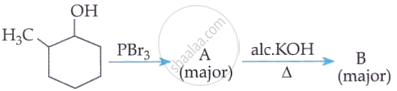
Major products A and B formed in the following reaction sequence are: