Advertisements
Advertisements
प्रश्न
The conversion of an alkyl halide into an alkene by alcoholic KOH is classified as ______.
विकल्प
a substitution reaction
an addition reaction
a dehydrohalogenation reaction
a dehydration reaction
Advertisements
उत्तर
The conversion of an alkyl halide into an alkene by alcoholic KOH is classified as a dehydrohalogenation reaction.
Explanation:
When an alkyl halide is treated with an alcoholic solution of potassium hydroxide (KOH), hydrogen halide is removed. It leads to the production of alkene. This is an example of a dehydrohalogenation (β-elimination) reaction.
APPEARS IN
संबंधित प्रश्न
Identify ‘A’ and ‘B’ in the following reaction :
\[\ce{CH3 - CH = CH2 ->[HBr]'A' ->[alc.KOH]'B'}\]
How do you convert 2-bromobutane to but-2-ene?
Predict all the alkenes that would be formed by dehydrohalogenation of the following halide with sodium ethoxide in ethanol and identify the major alkene:
2-Chloro-2-methylbutane
Predict all the alkenes that would be formed by dehydrohalogenation of the following halide with sodium ethoxide in ethanol and identify the major alkene:
2, 2, 3-Trimethyl-3-bromopentane
Identify the major product formed when 2-cyclohexylchloroethane undergoes a dehydrohalogenation reaction. Name the reagent which is used to carry out the reaction.
Elimination of bromine from 2-bromobutane results in the formation of ______.
A primary alkyl halide would prefer to undergo ______.
Reaction of trans-2-phenyl-1-bromocyclopentane with alcoholic KOH produces.
An SN1 reaction at the asymmetric carbon of an enantiomerically pure chiral alkyl halide gives a product ______.
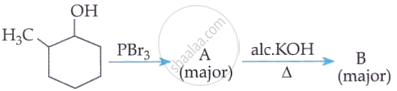
Major products A and B formed in the following reaction sequence are: