Advertisements
Advertisements
प्रश्न
How the author and his friend spent the entire day?
Advertisements
उत्तर
The author’s friend dismantled the bicycle parts one-by-one for the entire day and then he spent the entire day fixing them at their place.
संबंधित प्रश्न
Explain what the reason for the following is .
Einstein seeing in Mileva an ally.
Discuss in pair and answer question below in a short paragraph (30 − 40 words.
Where did Jerome finally find the toothbrush?
Take down the following scrambled version of a story, that your teacher will dictate to
you, with appropriate punctuation marks. Then, read the scrambled story carefully and try to rewrite it rearranging the incidents. A grasshopper, who was very hungry, saw her and said, “When did you get the corn? I am dying of hunger.” She wanted to dry them. It was a cold winter’s day, and an ant was bringing out some grains of corn from her home. She had gathered the corn in summer. “I was singing all day,” answered the grasshopper.
“If you sang all summer,” said the ant, “you can dance all winter.”
“What were you doing?” asked the ant again.
The grasshopper replied, “I was too busy.”
“I collected it in summer,” said the ant. “What were you doing in summer? Why did you not store some corn?”
What does the swallow see when it flies over the city?
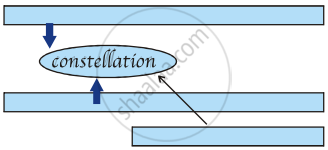
Read the following extracts from the story, and try to puzzle out the meanings of the encircled words from other words and phrases in the extract. Write the clues in the empty boxes. Then give your own explanation of the encircled words.
I saw individual stars, but I could not distinguish the constellation they belonged to. Then dawn came and put out all my stars.
Therefore, constellation means ______.
Some are Purple and gold flecked grey
For she who has journeyed through life midway,
Whose hands have cherished , whose love has blest,
And cradled fair sons on her faithful breast,
And serves her household in fruitful pride,
And worship the gods at her husband's side.
Read the lines given above and answer the question that follow:
The patriarchal system is referred in this stanza. Quote.
"My father lived at Blenheim then,
Yon little stream hard by;
They burnt his dwelling to the ground,
And he was forced to fly;
So with his wife and child he fled,
Nor had he where to rest his head.
"With fire and sword the country round
Was wasted far and wide,
And many a childing mother then,
And new-born baby died;
But things like that, you know, must be
At every famous victory;
Read the lines given above and answer the question that follow.
What does Kasper’s attitude signify?
We will ponder your proposition and when we decide we will let you know. But should we accept it, I here and now make this condition that we will not be denied the privilege without molestation of visiting at any time the tombs of our ancestors, friends, and children. Every part of this soil is sacred in the estimation of my people. Every hillside, every valley, every plain and grove, has been hallowed by some sad or happy event in days long vanished. Even the rocks, which seem to be dumb and dead as the swelter in the sun along the silent shore, thrill with memories of stirring events connected with the lives of my people, and the very dust upon which you now stand responds more lovingly to their footsteps than yours, because it is rich with the blood of our ancestors, and our bare feet are conscious of the sympathetic touch. Our departed braves, fond mothers, glad, happy hearted maidens, and even the little children who lived here and rejoiced here for a brief season, will love these somber solitudes and at eventide they greet shadowy returning spirits. And when the last Red Man shall have perished, and the memory of my tribe shall have become a myth among the White Men, these shores will swarm with the invisible dead of my tribe^ and when your children’s children think themselves alone in the field, the store, the shop, upon the highway, or in the silence of the pathless woods, they will not be alone. In all the earth there is no place dedicated to solitude. At night when the streets of your cities and villages are silent and you think them deserted, they will throng with the returning hosts’that once filled them and still lover this beautiful land. The White Man will never be alone.
Let him be just and deal kindly with my people, for the dead are not powerless. Dead, did I say? There is no death, only a change of worlds.
Read the extract given below and answer the question that follow.
What is the condition laid by the speaker before he accepts the white man’s proposition?
He flungs himself down in a corner to recoup from the fatigue of his visit to the shop. His wife said, “You are getting no sauce today, nor anything else. I can’t find anything to give you to eat. Fast till the evening, it’ll do you good. Take the goats and be gone now,” she cried and added, “Don’t come back before the sun is down.”
Read the extract given below and answer the question that follow.
Did The shopkeeper give Muni what he needed? Why/ Why not?
Complete the following sentence by adding the appropriate part of the sentence given below.
Many wise men answered the king’s questions, _______________.
“Have you children...” she began, and then, seeing they were curiously quiet, went on more slowly, “seen anyone lurking around the verandah?”
(i) What do you think Rukku Manni really wanted to ask?
(ii) Why did she change her question?
(iii) What did she think had happened?
On getting a gift of chappals, the beggar vanished in a minute. Why was he in such a hurry to leave?
Mark the right item.
The old farmer and his wife loved the dog
How did Mr Gessler described his brother?
Name the narrator in the lesson ‘Expert Detectives’.
What items of food did Golu take before leaving his home for the Limpopo river?
Word in the box given below indicates a large number of… For example, ‘a herd of cows’ refers to many cows. Complete the following phrase with a suitable word from the box.
a _________________ of flowers
Multiple Choice Question:
According to the poet, a lot is left unsaid because of _________.
Who is the speaker?
Referring closely to the poem, Dover Beach, show how the poet correlates the gradual receding of the "Sea of Faith" with the gradual loss of human faith in religion.
