Advertisements
Advertisements
प्रश्न
How many persons can be accommodated in a big-hall of dimensions 40 m, 25 m, and 15 m; assuming that each person requires 5 m3 of air?
Advertisements
उत्तर
[No. of persons = `" Vol. of the hall"/"Vol. of air required for each person"`]
Length of the hall = 40 m
breadth = 25 m
Height = 15 m
Volume of the hall = `"L" xx "B" xx "H"`
= `40 xx 25 xx 15`
= 15000 m3
The volume of the air required for each person = 5m3
No. of persons who can be accommodated = `" Volume of the hall"/"Volume of air required for each person"`
= `(15000 "m"^3)/(5 "m"^3)`
= 3000
APPEARS IN
संबंधित प्रश्न
A plastic box 1.5 m long, 1.25 m wide and 65 cm deep, is to be made. It is to be open at the top. Ignoring the thickness of the plastic sheet, determine:
(i) The area of the sheet required for making the box.
(ii) The cost of sheet for it, if a sheet measuring 1 m2 costs Rs 20.
Shanti Sweets Stall was placing an order for making cardboard boxes for packing their sweets. Two sizes of boxes were required. The bigger of dimensions 25 cm × 20 cm × 5 cm and the smaller of dimensions 15 cm × 12 cm × 5 cm. For all the overlaps, 5% of the total surface area is required extra. If the cost of the cardboard is Rs 4 for 1000 cm2, find the cost of cardboard required for supplying 250 boxes of each kind.
The length, breadth and height of a room are 5 m, 4 m and 3 m respectively. Find the cost
of white washing the walls of the room and the ceiling at the rate of Rs. 7.50 m2.
A cuboidal block of silver is 9 cm long, 4 cm broad and 3.5 cm in height. From it, beads of volume 1.5 cm3 each are to be made. Find the number of beads that can be made from the block.
A tank is 8 m long, 6 m broad and 2 m high. How much water can it contain?
A water tank is 3 m long, 2 m broad and 1 m deep. How many litres of water can it hold?
A village, having a population of 4000, requires 150 litres water per head per day. It has a tank which is 20 m long, 15 m broad and 6 m high. For how many days will the water of this tank last?
The rainfall on a certain day was 6 cm. How many litres of water fell on 3 hectares of field on that day?
If V is the volume of a cuboid of dimensions a, b, c and S is its surface area, then prove that \[\frac{1}{V} = \frac{2}{S}\left( \frac{1}{a} + \frac{1}{b} + \frac{1}{c} \right)\]
A rectangular water reservoir contains 105 m3 of water. Find the depth of the water in the reservoir if its base measures 12 m by 3.5 m.
The dimensions of a rectangular box are in the ratio of 2 : 3 : 4 and the difference between the cost of covering it with sheet of paper at the rates of Rs 8 and Rs 9.50 per m2 is Rs. 1248. Find the dimensions of the box.
If the length of a diagonal of a cube is `8 sqrt(3)` cm, then its surface area is
A cuboid has total surface area of 372 cm2 and its lateral surface area is 180 cm2, find the area of its base.
Three cubes of each side 4 cm are joined end to end. Find the surface area of the resulting cuboid.
The surface area of a cuboid is 1300 cm2. If its breadth is 10 cm and height is 20 cm2, find its length.
Find the volume and the total surface area of a cuboid, whose :
l = 3.5 m, b = 2.6 m and h = 90 cm
The volume of a cuboid is 3456 cm3. If its length = 24 cm and breadth = 18 cm ; find its height.
A tank 30 m long, 24 m wide, and 4.5 m deep is to be made. It is open from the top. Find the cost of iron-sheet required, at the rate of ₹ 65 per m2, to make the tank.
The internal length, breadth, and height of a closed box are 1 m, 80 cm, and 25 cm. respectively. If its sides are made of 2.5 cm thick wood; find :
(i) the capacity of the box
(ii) the volume of wood used to make the box.
The length breadth and height of a cuboid are in the ratio of 3 : 3 : 4. Find its volume in m3 if its diagonal is `5sqrt(34)"cm"`.
How much sheet metal is required to make a closed rectangular box of length 1.5 m, breadth 1.2 m, and height 1.3 m?
Opposite faces of a cuboid are ______ in area.
The areas of any two faces of a cuboid are equal.
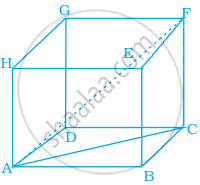
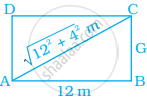
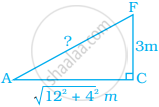
Find the length of the largest pole that can be placed in a room of dimensions 12 m × 4 m × 3 m.