Advertisements
Advertisements
प्रश्न
The ratio between the curved surface area and the total surface area of a cylinder is 1: 2. Find the ratio between the height and the radius of the cylinder.
Advertisements
उत्तर
Let r be the radius and h be the height of a right circular cylinder, then Curved surface area = 2πrh
and total surface area = 2πrh x 2πr2 = 2πr(h + r)
But their ratio is 1: 2
`therefore (2pirh)/(2pir(h + r)) = 1/2`
⇒ `h/(h + r) = 1/2`
⇒ 2h = h + r
⇒ 2h - h = r
⇒ h = r = 1 : 1
Hence, their radius and height are equal.
APPEARS IN
संबंधित प्रश्न
Find the height of a cuboid whose base area is 180 cm2 and volume is 900 cm3?
A cuboid is of dimensions 60 cm × 54 cm × 30 cm. How many small cubes with side 6 cm can be placed in the given cuboid?
The length, breadth and height of a room are 5 m, 4 m and 3 m respectively. Find the cost
of white washing the walls of the room and the ceiling at the rate of Rs. 7.50 m2.
The length of a hall is 18 m and the width 12 m. The sum of the areas of the floor and the
flat roof is equal to the sum of the areas of the four walls. Find the height of the hall.
The length and breadth of a hall are in the ratio 4: 3 and its height is 5.5 metres. The cost of decorating its walls (including doors and windows) at Rs. 6.60 per square metre is Rs. 5082. Find the length and breadth of the room.
A cuboidal wooden block contains 36 cm3 wood. If it be 4 cm long and 3 cm wide, find its height.
How many wooden cubical blocks of side 25 cm can be cut from a log of wood of size 3 m by 75 cm by 50 cm, assuming that there is no wastage?
Find the number of cuboidal boxes measuring 2 cm by 3 cm by 10 cm which can be stored in a carton whose dimensions are 40 cm, 36 cm and 24 cm.
Find the volume in cubic metre (cu. m) of the cuboid whose dimensions is length = 12 m, breadth = 10 m, height = 4.5 cm.
How much clay is dug out in digging a well measuring 3 m by 2 m by 5 m?
A rectangular diesel tanker is 2 m long, 2 m wide and 40 cm deep. How many litres of diesel can it hold?
A water tank is 3 m long, 2 m broad and 1 m deep. How many litres of water can it hold?
An 8 m long cuboidal beam of wood when sliced produces four thousand 1 cm cubes and there is no wastage of wood in this process. If one edge of the beam is 0.5 m, find the third edge.
Find the surface area of a cuboid whoselength = 3.2 m, breadth = 30 dm, height = 250 cm.
Show that the product of the areas of the floor and two adjacent walls of a cuboid is the square of its volume.
The walls and ceiling of a room are to be plastered. The length, breadth and height of the room are 4.5 m, 3 m and 350 cm, respectively. Find the cost of plastering at the rate of Rs 8 per square metre.
If the perimeter of each face of a cube is 32 cm, find its lateral surface area. Note that four faces which meet the base of a cube are called its lateral faces.
The length of the longest rod that can be fitted in a cubical vessel of edge 10 cm long, is
Volume of a cuboid is 12 cm3. The volume (in cm3) of a cuboid whose sides are double of the above cuboid is
A solid cuboid of metal has dimensions 24 cm, 18 cm, and 4 cm. Find its volume.
A wall 9 m long, 6 m high and 20 cm thick, is to be constructed using bricks of dimensions 30 cm, 15 cm, and 10 cm. How many bricks will be required?
Find the volume of wood required to make a closed box of external dimensions 80 cm, 75 cm, and 60 cm, the thickness of walls of the box being 2 cm throughout.
Find the area of metal-sheet required to make an open tank of length = 10 m, breadth = 7.5 m and depth = 3.8 m.
Find the height of the cylinder whose radius is 7 cm and the total surface area is 1100 cm2.
The length and breadth of a cuboid are 20 cm and 15 cm respectively. If its volume is 2400 cm3, find its height.
Find the Total Surface Area and the Lateral Surface Area of a cuboid whose dimensions are: length = 20 cm, breadth = 15 cm, height = 8 cm
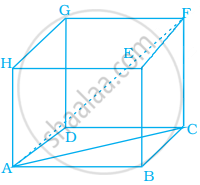
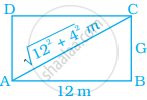
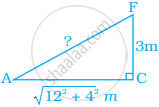
Find the length of the largest pole that can be placed in a room of dimensions 12 m × 4 m × 3 m.
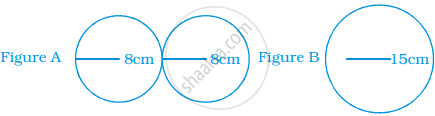
Below are the drawings of cross sections of two different pipes used to fill swimming pools. Figure A is a combination of 2 pipes each having a radius of 8 cm. Figure B is a pipe having a radius of 15 cm. If the force of the flow of water coming out of the pipes is the same in both the cases, which will fill the swimming pool faster?