Advertisements
Advertisements
प्रश्न
How electric current flows in solids?
Advertisements
उत्तर
Flow of electric current in solids: In solids, the positive charges are associated with atomic nuclei. As the nuclei are firmly packed and closely held by inter-atomic forces, therefore, positive charges cannot drift.
On the other hand, negative charges (electrons) are not held firmly. Thus, when a potential difference, however small, is applied, they start drifting from a lower to a higher potential. The continuous drift of electrons through the body of a solid conductor constitutes the current.
APPEARS IN
संबंधित प्रश्न
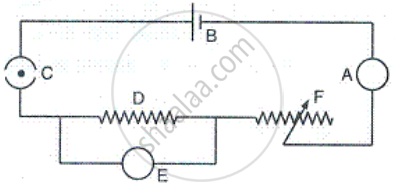
In the electric circuit shown in Figure, label the parts A, B, C, D, E, and F. State the function of each part. Show in the diagram the direction of flow of current.
The unit of current is :
How is the resistance of a wire affected if its (a) length is doubled, (b) radius is doubled?
Name the physical quantity of which the unit is ohm
What do you understand by the term electric potential?
Assuming that the charges of an electron is 1.6 × 10⁻¹⁹ coulombs, the number of electrons passing through a section of wire per sec, when the wire carries a current of one ampere is:
'The resistance of a wire is 2 ohm'. Explain the meaning of this statement.
