Advertisements
Advertisements
प्रश्न
How electric current flows in solids?
Advertisements
उत्तर
Flow of electric current in solids: In solids, the positive charges are associated with atomic nuclei. As the nuclei are firmly packed and closely held by inter-atomic forces, therefore, positive charges cannot drift.
On the other hand, negative charges (electrons) are not held firmly. Thus, when a potential difference, however small, is applied, they start drifting from a lower to a higher potential. The continuous drift of electrons through the body of a solid conductor constitutes the current.
APPEARS IN
संबंधित प्रश्न
What transformation of energy takes place when current is drawn from a cell?
What is the function of a key (or switch) in an electric circuit?
Write symbol and state function of following component in an electric circuit : key
When starter motor of a car is switched on for 0.8 s . a charge 24 C passes through the coil of the motor . Calculate the current in the coil .
'The resistance of a wire is 1 ohm'. Explain the meaning of this statement.
4 × 10²⁰ electrons flow through a circuit in 10 hours. Calculate magnitude of current. [1 e- = 1.6 × 10⁻¹⁹ C]
The following figure shows a metal rod PQ mounted on an insulated stand. The cap of an uncharged electroscope touches one end Q of the metal rod. A negatively charged ebonite rod is brought near the other end P of the metal rod.
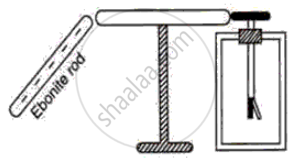
(a) What charge does the end P have?
(b) What charge does the end Q have?
(c) What charge does the cap of the electroscope have?
(d) What charge does the gold leaf have?
(e) Will the leaf diverge or collapse? Give reason.
(f) If the electroscope is now earthed, what charge does the metal rod have?
