Advertisements
Advertisements
प्रश्न
How electric current flows in liquids?
Advertisements
उत्तर
Flow of electric current in liquids: Within a liquid no electrons move. However, when a negatively charged and a positively charged electrodes are placed in a liquid, it sets up an electric field.
Under the influence of the electric field, the positively charged ions migrate towards the negatively charged electrode and vice versa.
At the cathode, the positively charged ions gain electrons. At the anode the negatively charged ions lose same number of electrons.
Thus, in a way number of electrons given by the cathode is equal to the number of electrons accepted by the anode. The sum up, we can say that simultaneous movement and discharge of positive and negative ions in the opposite directions constitute the current in the liquids.
APPEARS IN
संबंधित प्रश्न
What is a primary cell?
Write symbol and state function of following component in an electric circuit :
cell
State whether the resistance of filament of a bulb will decrease, remain unchanged or increase when it glows.
A charge of 8860 C flows through an electric circuit in 2 min and 40 s. Calculate the magnitude of current in a circuit.
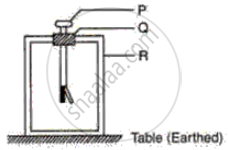
The following Figure represents a negatively charged gold Ieaf electroscope. Label the parts, P, Q, and R and the estate whether each is an insulator or a conductor. Also, indicate the distribution of charges on the system in the diagram.
What is the other name of a variable resistor?
What is the function of a switch in an electric circuit?
What do you mean by the potential difference? Write its SI unit.
