Advertisements
Advertisements
प्रश्न
Higher Order Thinking Skill.
Imagine that student A studied the importance of certain factors in photosynthesis. He took a potted plant and kept it in dark for 24 hours. In the early hours of the next morning, he covered one of the leaves with dark paper in the centre only. Then he placed the plant in sunlight for a few hours and tested the leaf which was covered with black paper for starch.
- What aspect of photosynthesis was being investigated?
- Why was the plant kept in the dark before the experiment?
- How will you prove that starch is present in the leaves?
- Name the raw materials needed for photosynthesis.
Advertisements
उत्तर
a) The student aimed to study the role of light and its effect on photosynthesis.
b) Photosynthesis is a process in plants to synthesize sugars that are required for the plant activities and for its survival with light source.
- Keeping plants in dark before the experiment will temporarily stop the production of sugars like starch.
- And only depend on the stored starch and utilize it completely.
c) Then initiation of the experiment is done by closing a part of the leaf to avoid photosynthesis in that part.
- And kept in the Sun light for photosynthesis to happen.
- After the adequate time the leaf is heat boiled in water and bleached in alcohol to stop all the reactions and remove leaf components.
- This is then stained with iodine, presence of starch is indicated with blue color. And the covered portion of the leaf does not give any color indicating absence of starch.
- Leaf part with presence of starch shows the processed photosynthesis in presence of light.
- And the no colored part of leaf shows absence of photosynthesis.
d) Apart from light, Carbon dioxide and water are the raw materials for photosynthesis.
APPEARS IN
संबंधित प्रश्न
Given below is an experimental setup to demonstrate a particular tropic movement in germinating seeds. Study the diagram and answer the questions that follow:
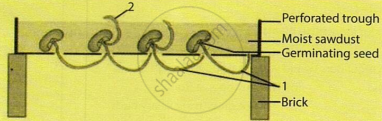
- Label the parts 1 and 2.
- Name the tropic movement shown by part 1.
- Part 1 is affected by two stimuli. Name them. Which one of the two is stronger?
- What is thigmotropism? Give one example.
- What is meant by 'Positive' and 'Negative' tropic movements in plants?
Given below is an experiment setup to demonstrate a particualr tropic movement in germinating seeds. Study the diagram and answer the questions that follow :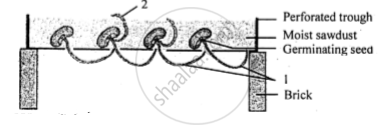
(ii) Name the tropic movement shown by part 1.
Given below is an experiment setup to demonstrate a particualr tropic movement in germinating seeds. Study the diagram and answer the questions that follow :
What is meant by ‘Positive’ and ‘Negative’ tropic movements in plants?
Choose the correct answer:
In a typical leaf, photosynthesis occurs mainly in ___________
Name the following:
The tissue that transports manufactured type of starch from leaves to all parts of the plants.
Mention one difference between the following on the basis of what is given in bracket.
Producers and consumers (mode of nutrition)
Name the following:
The process by which plants produce their food.
Name the following:
Source of oxygen given out in photosynthesis.
Mention four factors required for photosynthesis?
A potted plant with variegated leafes was kept in dark for 24 hours and then placed in bright sunlight. Answer the following questions.
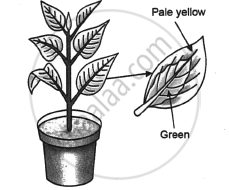
- Which aspect of photosynthesis is being tested in the above diagram?
- Why was the plant kept in the dark for 24 hours?
- After the starch test, what will be the colour of the yellow and green parts of the leaf? Give reasons to support your answer.
