हिंदी

Gold and silver are active metals.

Advertisements
Advertisements

प्रश्न

Gold and silver are active metals.

विकल्प

  • Right

  • Wrong

MCQ
सत्य या असत्य
Advertisements

उत्तर

Gold and silver are active metals- Wrong

shaalaa.com
  क्या इस प्रश्न या उत्तर में कोई त्रुटि है?
अध्याय 8: Metallugy - Right or Wrong sentence [पृष्ठ २१]

APPEARS IN

संबंधित प्रश्न

The rocky material found with ores is called ______.


Which metal is extracted from bauxite ore?


An ore of manganese metal is ______.


The two metals which are extracted by means of electrolytic reduction of their molten salts are ______.


Manganese metal is extracted from manganese dioxide by a reduction process by making use of ______.


When an object made of metal A is kept in air for a considerable time, it loses its shine and becomes almost black due to the formation of a layer of substance B. When an object made of another metal C is kept in damp air for a considerable time, it gets covered with a green layer of substance D. Metal A is the best conductor of electricity whereas metal C is the next best conductor of electricity.

  1. What is metal А?
  2. What is metal C?
  3. Name the substance B.
  4. Name the substance D.
  5. What type of chemical can be used to remove the green layer from metal C and clean it? Why?

Some metallic oxides can be reduced by hydrogen, carbon and carbon monoxide and some cannot. Explain.


Distinguish between ‘roasting’ and ‘calcination’. Which of these two is used for sulphide ores and why?


Explain the following:
Galvanization protects iron from rusting.


Write equations for each of the above metal which reacts with water.


How many valence electrons are present in metals ?


Compare the properties of a typical metal and a non- metal on the basis of the following:
(a) electronic configuration
(b) nature of oxides
(c) oxidizing or reducing action
(d) conductivity of heat and electricity


Which one of the following is not true of metal :
Metal will have 1 or 2 or 3 electrons in their valence shell.


Froth floatation process is generally used to concentrate ______ ores.


Extraction of moderately reactive elements is done by _______ and _______ method.


Mercury, silver, gold are highly reactive metals.


Explain the following reaction with the balanced equation.

Zinc carbonate is heated strongly in limited supply of air


Observe the following diagram and write answers.
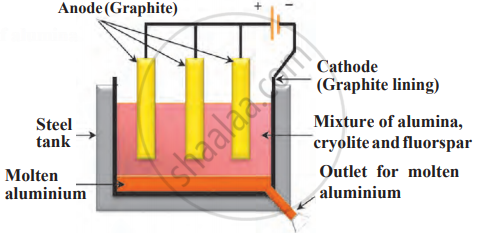
  1. Name the method.
  2. Write anode reaction and cathode reaction.
  3. Why fluorspar and cryolite are added in the mixture?

Answer the questions on the following passage.

The minerals from which the metal can be separated economically are called ores. Ores contain many types of impurities such as soil, sand and rocky substances along with metal compounds. These impurities are called gangue.
Metals can be extracted from their ores by means of various methods of separation. The process of extraction of metal in a pure state from the ores is also a part of metallurgy.
Ores are taken out from the mines and the gangue is usually separated from the ore at the site itself by various methods. Then the ores are carried out to the place where metals are produced. Here metals are extracted in pure form. Then metals are further purified by different methods of purification. This entire process is called metallurgy. Most metals being reactive do not occur in nature in the free state but are found in combined state as their salts such as oxides, carbonates, sulphides, and nitrates. however, the most unreactive metals that are not affected by air, water and other natural factors like silver, gold, platinum, generally occur in a free state. The compounds of metals that occur in nature along with the impurities are called minerals.

  1. What are ores?
  2. Which processes are involved in the branch of metallurgy? What is metallurgy?
  3. Which metals are found in a free state?
  4. In what forms are metals found in combined state?
  5. What is gangue?

Explain the difference between Bayer’s process and Hall’s process by explaining the Bayer’s process.


Share
Notifications

Englishहिंदीमराठी


      Forgot password?
Use app×