Advertisements
Advertisements
प्रश्न
Given: Parallelogram ABCD in which diagonals AC and BD intersect at M.
Prove: M is the mid-point of LN.
Advertisements
उत्तर
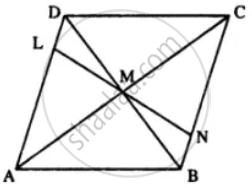
Proof: Diagonals of //gm bisect each other.
MD = MB
Also ∠ADB = ∠DBN (Alternate ∠s)
& ∠DML = ∠BMN (Vert. opp. ∠s)
∆DML = ∆BMN
LM = MN
M is mid-point of LN.
Hence proved.
APPEARS IN
संबंधित प्रश्न
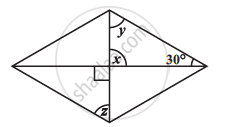
Consider the given parallelograms. Find the values of the unknowns x, y, z.
Can a quadrilateral ABCD be a parallelogram if ∠D + ∠B = 180°?
Name the quadrilaterals whose diagonals bisect each other
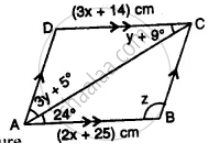
Use the information given in the alongside diagram to find the value of x, y, and z.
Which of the following is a property of a parallelogram?
The angle between the two altitudes of a parallelogram through the same vertex of an obtuse angle of the parallelogram is 30°. The measure of the obtuse angle is ______.
In parallelogram MODE, the bisector of ∠M and ∠O meet at Q, find the measure of ∠MQO.
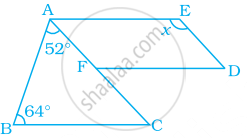
In the following figure, FD || BC || AE and AC || ED. Find the value of x.
Construct a parallelogram HOME with HO = 6 cm, HE = 4 cm and OE = 3 cm.
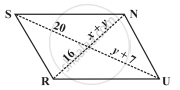
The following figure RUNS is parallelogram. Find x and y. (Lengths are in cm)