Advertisements
Advertisements
प्रश्न
Given diagram is a schematic representation of the circulatory system in humans. Study the same and answer the questions that follow:
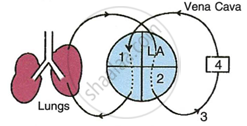 |
- Label the parts 1 and 4 indicated in the diagram.
- Which of the above mentioned number is the thickest artery? Also write its name.
- Mention the number and chamber of the heart which has the thickest muscular wall.
- Which of the above numbers/structures has the maximum number of blood capillaries?
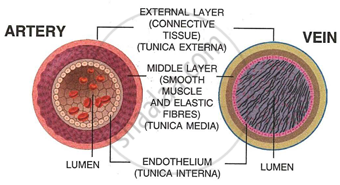
- Draw neat and labelled diagrams of the transverse section of vena cava and the part numbered as 3. Make sure to show the structural differences between these two in the diagram.
Advertisements
उत्तर
-
- Right auricle
- Left ventricle
- Aorta
- Body organs
- Number 3 is the thickest artery. The artery's name is Aorta.
- Number 2 has the thickest muscular wall, which is the left ventricle.
- The small intestine has the maximum number of blood capillaries.
APPEARS IN
संबंधित प्रश्न
The exact location of the tricuspid valve
Given alongside is a diagram of human heart showing its internal structures. Label the parts marked 1 to 6, and answer the following questions.

- Which type of blood is carried by the blood vessel marked 2?
- Name the main artery which takes the blood from heart to different parts of the body?
- Which chamber of the heart receives deoxygenated blood from the body?
What is Diapedesis?
When are the sounds "LUBB" and "DUP" produced respectively during heart beat?
What is haemoglobin? State the consequences of deficiency of haemoglobin in our bodies.
Which side of the heart (left or right) contains oxygenated blood?
The table below is designed to indicate the transport of certain substances in our body. Fill in the blanks with suitable answers.
| Substance | From | To | |
| 1. | ______ | Lungs | Whole Body |
| 2. | Carbon Dioxide | ______ | ______ |
| 3. | Urea | ______ | ______ |
| 4. | Digested Carbohydrates | Intestines | ______ |
| 5. | ______ | ______ | Target Organs |
| 6. | Heat | ______ | Whole Body |
Long answer question:
Describe human blood and give its functions.
______ is a granulocyte.
