Advertisements
Advertisements
प्रश्न
Given diagram is a schematic representation of the circulatory system in humans. Study the same and answer the questions that follow:
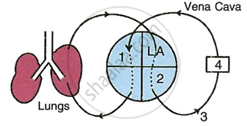 |
- Label the parts 1 and 4 indicated in the diagram.
- Which of the above mentioned number is the thickest artery? Also write its name.
- Mention the number and chamber of the heart which has the thickest muscular wall.
- Which of the above numbers/structures has the maximum number of blood capillaries?
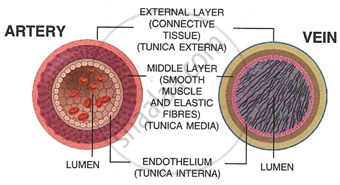
- Draw neat and labelled diagrams of the transverse section of vena cava and the part numbered as 3. Make sure to show the structural differences between these two in the diagram.
Advertisements
उत्तर
-
- Right auricle
- Left ventricle
- Aorta
- Body organs
- Number 3 is the thickest artery. The artery's name is Aorta.
- Number 2 has the thickest muscular wall, which is the left ventricle.
- The small intestine has the maximum number of blood capillaries.
APPEARS IN
संबंधित प्रश्न
Note the relationship between the first two words and suggest the suitable word/ word for the
fourth place:
Lubb: Atrioventricualr valves :: dup: …………………
Put a tick mark (✓) against the correct alternative in the following statement.
The blood tastes saltish due to the dissolved.
Define the Circulatory system.
Define the Arteries.
What are seen as greenish blue lines in our hands and legs?
Choose the correct alternative.
What is the minimum number of the plasma membrane that oxygen has to diffuse across to pass from air in the alveolus to haemoglobin inside a RBC?
Long answer question:
Describe human blood and give its functions.
______ is a granulocyte.
Agranulocytes are about ______ % of total WBCs.
Given below are four statements regarding human blood circulatory system:-
- Arteries are thick walled and have narrow lumen as compared to veins.
- Angina is acute chest pain when the blood circulation to the brain is reduced.
- Persons with blood group AB can donate blood to any person with any blood group under ABO system.
- Calcium ions play a very important role in blood clotting.
Which two of the above statements are correct?
