Advertisements
Advertisements
प्रश्न
Given alongside are diagrams of a certain category of blood vessels showing the role of a special structure in their walls. Study the figure and answer the questions that follow.
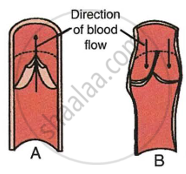 |
- Name the kind of blood vessels shown in the figure. What are its branches termed as?
- Name the structure shown inside the blood vessels. Write its important role.
- What kind of blood flows through these blood vessels normally? Name the blood vessel which carries blood from the heart to the lungs.
- Name a similar kind of blood vessel which is related to the liver and kidney.
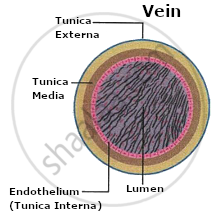
- Draw a neat and labelled diagram of the transverse section of the blood vessel shown above showing the three layers of its wall and lumen.
दीर्घउत्तर
Advertisements
उत्तर
- Veins are shown in the figure. Its branches are called venules.
- The structure is known as valves. Valves prevent the backflow of blood.
- Veins transport partially deoxygenated, CO2-laden blood. The pulmonary arteries carry blood from the heart to the lungs.
- "Hepatic vein" refers to the liver, and "renal vein" refers to the kidney. These veins transport blood from the liver and kidney, respectively.
shaalaa.com
क्या इस प्रश्न या उत्तर में कोई त्रुटि है?
