Advertisements
Advertisements
प्रश्न
Given in the box below are a set of 14 biological terms. Of these, 12 can be paired into 6 matching pairs. Out of the six pairs, one has been done for you as an example.
Example : endosmosis - Turgid cell.
Identify the remaining five matching pairs :
| Cushing’s syndrome, Turgid cell, Iris, Free of rod and cone cells, Colour of eyes, Hypoglycemia, Active transport, Acrosome, Addison’s disease, Blind spot, Hyperglycemia, Spermatozoa, Endosmosis, Clotting of blood. |
Advertisements
उत्तर
(i) Blind spot: Free of rods and cones
(ii) Acrosome: Spermatozoa
(iii) Iris: Colour of eyes
(iv) Addison’s disease: Hypoglycemia
(v) Cushing’s syndrome: Hyperglycemia
APPEARS IN
संबंधित प्रश्न
Explain how the human ear works.
Differentiate between the Rods and Cones of Retina (Type of pigment)
The ear ossicle which is attached to the tympanum.
State the main function of the Suspensory ligament of the eye
Draw a neat and labelled diagram of the human ear. With the help of this diagram, explain the construction and working of the human ear.
Write whether the following is true or false:
The part of the ear associated with balance is the cochlea.
Choose the correct answer :
Organ of corti is found in ___________
Given below is a diagram of a part of the human ear. Study the same and answer the question that follow:
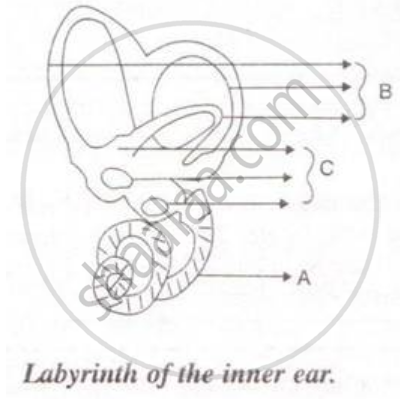
Name the parts labeled A, B and C in the diagram.
Draw a labeled diagram of the inner ear. Name the part of the inner ear that is responsible for static balance in human beings.
Given below is the diagram of a part of the human ear. Study the same and answer the questions that follow:
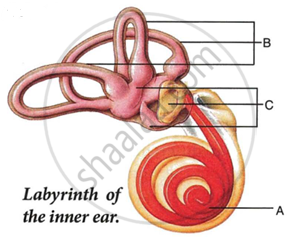 |
- Give the collective biological term for Malleus, locus and Stapes.
- Name the parts labelled A, B and C in the diagram.
- State the functions of the parts labelled 'A' and 'B'.
- Name the audio receptor region present in the part labelled 'A'.
