Advertisements
Advertisements
प्रश्न
Given below are the angles x, y, and z.
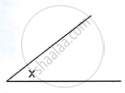
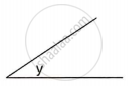
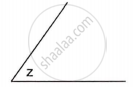
Without measuring these angles construct :
(i) (ii) (iii)
Advertisements
उत्तर
(i) Steps of Construction :
- Draw line segment BC of any suitable length.
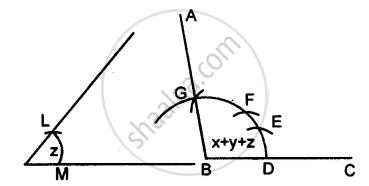
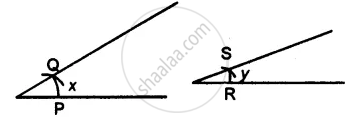
- With B as a centre, draw an arc of any suitable radius. With the same radius, draw arcs with the vertices of given angles as centres. Let these arcs cut arms of the angle x at the points P and Q and arms of the angle y at points R and S and arms of the angle z at the points L and M.
- From the arc, with centre B, cut
DE = PQ = arc of x, EF = RS = arc of y and FG = LM = arc of z. - Join BG and produce it up to A.
Then ∠ABC = x + y + z
(ii) Proceed as in part (i) up to step 2.
3. From the arc, with centre B, cut
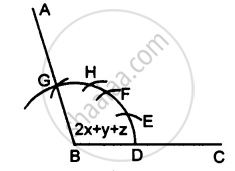
DE = 2PQ = 2 arc of x
EF = RS = arc of y
FG = LM = arc of z
4. Join BG and produce it up to point A
Then ∠ABC = 2x + y + z
(iii) proceed as in (i) up to step 2
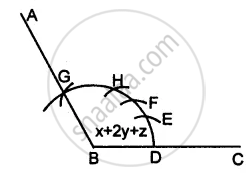
3. Here cut arc DE = arc PQ = arc of x arc EF = 2 arc RS = 2 arc of y arc FG = arc LM = arc of z.
4. Join BG and produce it up to A
5. Then ∠ABC = x + 2y + z
APPEARS IN
संबंधित प्रश्न
Given below are the angles x and y.
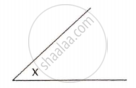
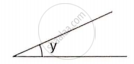
Without measuring these angles, construct :
(i)
(ii)
(iii)
Draw a line segment BC = 4 cm. Construct angle ABC = 60°.
Construct angle ABC = 45° in which BC = 5 cm and AB = 4.6 cm.
What is the first step when constructing an angle of a given measure using a protractor?
Which point is called the vertex in the construction of ∠ABC?
When using a compass to construct a 60° angle, what property enables this construction?
An angle bisector is the ray that divides the given angle into two parts that are:
If you want to construct an angle of 45°, what sequence is typically followed using compass and ruler?
