Advertisements
Advertisements
प्रश्न
Construct angle ABC = 45° in which BC = 5 cm and AB = 4.6 cm.
योग
Advertisements
उत्तर
Steps of Construction :
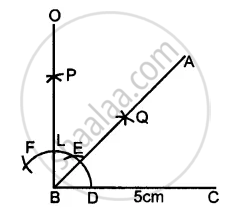
- Draw a line segment BC = 5 cm
- Taking B as centre, draw an arc of any suitable radius, which cuts BC at the point D.
- With D as the centre and the same radius, as taken in step 2, draw an arc which cuts the previous arc at point E.
- With E as the centre and the same radius, draw one more arc which cuts the first arc at point F.
- With E and F as centres and radii equal to more than half the distance between E at F, draw an arc which cut each other at point P.
- Join BP to meet EF at L and produce to point O. Then ∠OBC = 90°
- Draw BA, the bisector of angle OBC. [With D, L as centres and suitable radius draw two arc meeting each other at Q produced it to R]
=> ∠ABC = 45° [∴ BA is bisector of ∠OBC ∴ ∠ABC = = 45°] - From BR cut arc AB = 4.6 cm
shaalaa.com
क्या इस प्रश्न या उत्तर में कोई त्रुटि है?
APPEARS IN
संबंधित प्रश्न
Given below are the angles x and y.
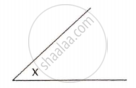
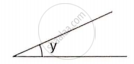
Without measuring these angles, construct :
(i)
(ii)
(iii)
Given below are the angles x, y, and z.
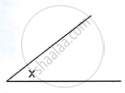
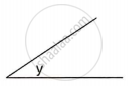
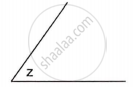
Without measuring these angles construct :
(i) (ii) (iii)
Draw a line segment BC = 4 cm. Construct angle ABC = 60°.
What is the first step when constructing an angle of a given measure using a protractor?
Which point is called the vertex in the construction of ∠ABC?
When using a compass to construct a 60° angle, what property enables this construction?
An angle bisector is the ray that divides the given angle into two parts that are:
If you want to construct an angle of 45°, what sequence is typically followed using compass and ruler?
