Advertisements
Advertisements
प्रश्न
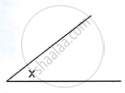
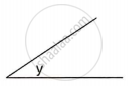
Given below are the angles x and y.
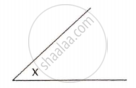
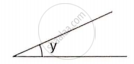
Without measuring these angles, construct :
(i)
(ii)
(iii)
Advertisements
उत्तर
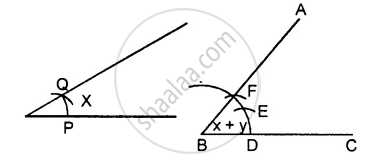
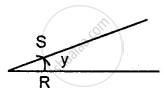
(i) Steps of Construction :
- Draw a line segment BC of any suitable length.
- With B as the centre, draw an arc of any suitable radius. With the same radius, draw arcs with the vertices of given angles as centres. Let these arcs cut arms of the arc x at points P and Q and arms of angle y at points R and S.
- From the arc, with centre B, cut DE = PQ arc of x and EF = RS arc of y
- Join BF and produce up to point A.
Thus ∠ABC = x + y
(ii) Steps of Construction :
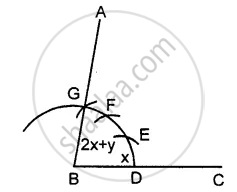
Proceed in exactly the same way as in part(i)
takes DE = PQ = arc of x.
EF = PQ = arc of x and FG = RS = arc of y.
Join BG and produce it up to A.
Thus ∠ABC = x + x+ y = 2x + y
(iii) Steps of Construction :
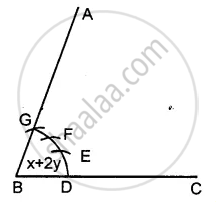
Proceed in exactly the same way as in (ii)
taking DE = PQ = arc of x. and EF = RS = arc of y and FG = RS = arc of y.
4. Join BF and produce up to point A.
Thus ∠ABC = x + y + y = x + 2y
APPEARS IN
संबंधित प्रश्न
Given below are the angles x, y, and z.
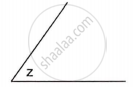
Without measuring these angles construct :
(i) (ii) (iii)
Draw a line segment BC = 4 cm. Construct angle ABC = 60°.
Construct angle ABC = 45° in which BC = 5 cm and AB = 4.6 cm.
What is the first step when constructing an angle of a given measure using a protractor?
Which point is called the vertex in the construction of ∠ABC?
When using a compass to construct a 60° angle, what property enables this construction?
An angle bisector is the ray that divides the given angle into two parts that are:
If you want to construct an angle of 45°, what sequence is typically followed using compass and ruler?
