Advertisements
Advertisements
प्रश्न
Give two characteristics of the chemical reaction which occurs on adding potassium iodide solution to lead nitrate solution.
Advertisements
उत्तर
On adding potassium iodide solution to lead nitrate solution, yellow precipitates of lead iodide are formed, and the colour of the solution changes from colourless to yellow. Hence, formation of a precipitate and a change in colour are the characteristics of this chemical reaction.
\[\ce{2KI_{(aq)} + Pb(NO3)2_{(aq)} -> PbI2_{(s)} + 2KNO3_{(aq)}}\]
APPEARS IN
संबंधित प्रश्न
Give an example of a double displacement reaction other than the one given in the following Activity.
•Take about 3 mL of sodium sulphate
solution in a test tube.
• In another test tube, take about 3 mL of
barium chloride solution.
• Mix the two solutions given in the following fig.
• What do you observe?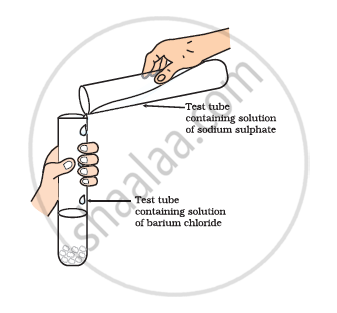
Write the balanced chemical equation for the following and identify the type of reaction.
\[\ce{Potassium bromide (aq) + Barium iodide (aq) -> Potassium iodide (aq) + Barium bromide (s)}\]
What do you mean by a precipitation reaction? Explain giving an example.
What is observed when a solution of sodium sulphate is added to a solution of barium chloride taken in a test tube? Write equation for the chemical reaction involved and name the type of reaction in this case.
What happens when silver nitrate solution is added to sodium chloride solution?
Name the type of reaction involved.
Consider the reaction:
\[\ce{KBr_{(aq)} + AgNO3_{(aq)} -> KNO3_{(aq)} + AgBr_{(s)}}\]
This is an example of:
A metal X forms a water soluble salt XNO3. When an aqueous solution of XNO3 is added to common salt solution, then a white precipitate of compound Y is formed along with sodium nitrate solution. Metal X is said to be the best conductor of electricity and it does not evolve hydrogen when put in dilute hydrohloric acid.
- What is metal X?
- What is salt XNO3?
- Name the compound Y.
- Write the chemical equation of the reaction which takes place on reacting XNO3 solution and common salt solution giving the physical states of all the reactants and products.
- What type of chemical reaction is illustrated by the above equation?
A red-brown metal X forms a salt XSO4. When hydrogen sulphide gas is passed through an aqueous solution of XSO4, then a black precipitate of XS is formed alongwith sulphuric acid solution.
- What could the salt XSO4 be?
- What is the colour of salt XSO4?
- Name the black precipitate XS.
- By using the formula of the salt obtained in (a) above, write an equation of the reaction which takes place when hydrogen sulphide gas is passed through its aqueous solution.
- What type of chemical reaction takes place in this case?
The aqueous solutions of copper sulphate and zinc sulphate appear
(A) blue and green respectively
(B) green and colourless respectively
(C) blue and brown respectively
(D) blue and colourless respectively.
Choose and write the correct option.
What is the type of the following reaction?
BaCl2 + ZnSO4 → BaSO4 + ZnCl2
When a potassium iodide solution is added to a solution of lead (II) nitrate in a test tube, a precipitate is formed.
List two types of reactions in which this reaction can be placed.
Classify the following reaction into –
- Direct combination
- Decomposition
- Displacement
- Double decomposition
The reaction is – Zinc sulphate reacts with ammonium hydroxide to give ammonium sulphate and zinc hydroxide.
Which of the following represents a precipitation reaction?
Which option denotes a double displacement reaction?
Which among the following is (are) double displacement reaction(s)?
(i) \[\ce{Pb + CuCl -> PbCl2 + Cu}\]
(ii) \[\ce{Na2SO4 + BaCl2 -> BaSO4 + 2NaCl}\]
(iii) \[\ce{C + O2 -> CO2}\]
(iv) \[\ce{CH4 + 2O2 -> CO2 + 2H2O}\]
Barium chloride on reacting with ammonium sulphate forms barium sulphate and ammonium chloride. Which of the following correctly represents the type of reaction involved?
(i) Displacement reaction
(ii) Precipitation reaction
(iii) Combination reaction
(iv) Double displacement reaction
