Give the formulae of the chlorides of the elements X and Y having atomic numbers of 3 and 6 respectively. Will the properties of the two chlorides be similar or different? Explain your answer.
Advertisements
Advertisements
प्रश्न
Give the formulae of the chlorides of the elements X and Y having atomic numbers of 3 and 6 respectively. Will the properties of the two chlorides be similar or different? Explain your answer.
Advertisements
उत्तर
The formula of the chloride of element X is XCl (or X+Cl−). Element X has an electronic configuration of 2, 1. When it reacts with chlorine with electronic configuration 2, 8, 7, it transfers one electron to the chlorine atom to form an ionic chloride compound.
The formula of the chloride of element Y is YCl4. Element Y has an electronic configuration of 2, 4. When it reacts with chlorine, which has the electronic configuration 2, 8, 7, it shares its four electrons with four chlorine atoms.
Properties of the two chlorides will be different because of the difference in the nature of bonding between them. For example, XCl, being ionic in nature, must have high melting and boiling points, but YCl4, being covalent in nature, must have low melting and boiling points.
APPEARS IN
संबंधित प्रश्न
State the reason to explain why covalent compounds "are bad conductors of electricity".
What would be the electron dot structure of a molecule of sulphur which is made up of eight atoms of sulphur? (Hint – the eight atoms of sulphur are joined together in the form of a ring.)
In forming oxygen molecule, ______ electrons are shared by each atom of oxygen.
The number of single covalent bonds in C2H2 molecule are ______.
Draw the electron-dot structure of the following compound and state the type of bonding in the given case:
CO2
Draw the electron-dot structure of the following compound and state the type of bonding in the given case:
HCl
Using electron-dot diagrams which show only the outermost shell electrons, show how a molecule of oxygen, O2, is formed from two oxygen atoms. What name is given to this type of bonding?
(At. No. of oxygen = 8)
Explain why, diamond is hard while graphite is soft (though both are made of carbon atoms).
What is graphite?
The number of covalent bonds in pentane (molecular formula C5H12) is ______.
A saturated hydrocarbon has fifty hydrogen atoms in its moleucle. The number of carbon atoms in its molecule will be ______.
Distinguish between ionic and covalent compounds under the following properties:
(i) Strength of forces between constituent elements
(ii) Solubility of compounds in water
(iii) Electrical conduction in substances
Draw an electron dot structure of the following molecule. (Without showing the circle) :
Methane
Draw all possible structural formulae of the compound from its molecular formula given below.
C3H8
Draw all possible structural formulae of the compound from its molecular formula given below.
C4H10
Explain the following term with an example.
Unsaturated hydrocarbon
Write answer as directed.
What causes the existance of very large number of carbon compound ?
Observe the straight chain hydrocarbons given below and answer the following
questions :
i) Which of the straight chain compounds from A and B is saturated and unsaturated straight chains?
ii) Name these straight chains.
iii) Write their chemical formulae and number of – CH2 - units.
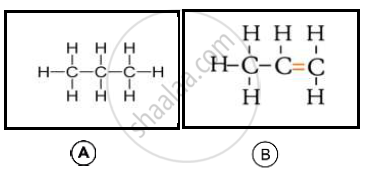
Explain the following:
Covalent compounds have low melting and boiling point.
Compare the compounds carbon tetrachloride and sodium chloride with regard to solubility in water and electrical conductivity.
An element L consists of molecules.
- Which type of bond is present in the particles that make up L?
- When L is heated with iron metal, it forms a compound FeL. What chemical term would you use to describe change undergone by L?
Draw an electron dot diagram to show the formation of the following compound.
Methane
[H = 1, C = 6]
Electrons are getting added to an element Y:
Is Y getting oxidised or reduced?
Explain why carbon tetrachloride does not dissolve in water.
Name two compounds that are covalent when taken pure but produce ions when dissolved in water.
Name the anion present in the following compound:
When a barium chloride solution is added to a solution of compound B, a white precipitate insoluble in dilute hydrochloric acid is formed.
Write the molecular formula of the given compound.
Acetic acid
Write scientific reason.
Benzene compounds are called aromatic compounds.
Write a short note.
Aromatic hydrocarbons
Complete the following activity.
Write the names of the hydrocarbons for the following structural formula.
(isobutylene, cyclohexane, propene, cyclohexene, cyclopentane, benzene, propyne, isobutane, propane)
| \[\begin{array}{cc}\ce{H}\phantom{...}\ce{H}\phantom{...}\ce{H}\\ |\phantom{....}|\phantom{....}|\\\ce{H - C - C - C - H}\\ |\phantom{....}|\phantom{....}|\\\ce{H}\phantom{...}\ce{H}\phantom{...}\ce{H} \end{array}\] |
Identify the incorrect statement and correct them.
- Like covalent compounds, coordinate compounds also contain charged particles (ions). So they are good conductors of electricity.
- Ionic bond is a weak bond when compared to Hydrogen bond.
- Ionic or electrovalent bonds are formed by mutual sharing of electrons between atoms.
- Loss of electrons is called Oxidation and gain of electron is called Reduction.
- The electrons which are not involved in bonding are called valence electrons.
Consider the coordination compound, K2[Cu(CN)4]. A coordinate covalent bond exists between:
The correct structural formula of butanoic acid is -
Two carbon atoms can always form one or two covalent bonds.
Oils on treating with hydrogen in the presence of palladium or nickel catalyst form fats. This is an example of
The table shows the electronic structures of four elements.
| Element | Electronic Structure |
| P | 2, 6 |
| Q | 2, 8, 1 |
| R | 2, 8, 7 |
| S | 2, 8, 8 |
- Identify which element(s) will form covalent bonds with carbon.
- “Carbon reacts with an element in the above table to form several compounds.” Give suitable reason.
State the reasons, why carbon cannot
- Lose four electrons to form C4+ cation and
- Gain four electrons to form C4- anion.
How does carbon overcome this problem to form compounds?
The electron dot structure of chlorine molecule is:
