Advertisements
Advertisements
प्रश्न
Advertisements
उत्तर
Atomic size increases down the group
- The atomic numbers of the elements increase as we go down the group. Thus, the elements placed lower have more electrons.
- To accommodate these electrons new shells are added to the atom.
- These new shells take the outermost electrons farther from the nucleus causing atomic size (radius) to increase as we go down the group.
APPEARS IN
संबंधित प्रश्न
Write the electronic configuration of K and Ne.
The elements Be, Mg and Ca each having two electrons in their outermost shells are in periods 2, 3, and 4 respectively of the modern periodic table. Answer the following questions, giving justification in each case:-
(i) Write the group to which these elements belong.
(ii) Name the least reactive element.
(iii) Name the element having largest atomic radius.
An element 'X' belong to 3rd period and group 13 of the Modern Periodic Table.
(a) Determine the valence electrons and the valency of 'X'.
(b) Molecular formula of the compound formed when 'X' reacts with an element 'Y' (atomic number = 8).
(c) Write the name and formula of the compound formed when 'X' combines with chlorine
Calcium is an element with atomic number 20. Stating reason, answer each of the following questions:-
(i) Is calcium a metal or a non-metal?
(ii) Will its atomic radius be larger or smaller than that of potassium with atomic number 19?
(iii) Write the formula of its oxide.
From the following elements :
4Be; 9F; 19K; 20Ca
(i) Select the element having one electron is the outermost shell.
(ii) two elements of the same group.
Write the formula of and mention the nature of the compound formed by the union of 19K and element X(2, 8, 7).
How do the valency and the atomic size of the elements vary while going from left to right along a period in the modern periodic table?
Name the element that has two shells, both of which are completely filled with electrons.
Which element has a total of two shells, with three electrons in its valence shell?
Choose the most appropriate answer of the following:
Which of the following would weigh the least?
(A) 2-gram atoms of Nitrogen.
(B) 1mole of Silver
(C) 22.4 liters of oxygen gas at 1 atmospheric pressure and 273K
(D) 6.02 x 10²³ atoms of carbon.
[Atomic masses: Ag=108, N=14, O=16, C=12]
Calculate the mass of Calcium that will contain the same number of the atom as are present in 3.2 gm of Sulphur.
[Atomic masses: S=32, Ca=40]
The metal of Group 2 from top to bottom arc Be, Mg, Ca, Sr, and Ba.
1) Which one of these elements will form ions most readily and why?
2) State the common feature in the electronic configuration of all these elements.
What happens to the metallic character of the elements as we go down in a group of the periodic table?
Nitrogen (atomic number 7) and phosphorus (atomic number 15) belong to group 15 of the periodic table. Write the electronic configuration of these two elements. Which of these will be more electronegative? Why?
What happens to the metallic character of the elements as we move from left to right in a period of the periodic table?
The electronic configuration of the atom of an element X is 2, 8, 4. In modern periodic table, the element X is places in :
(a) 2nd group
(b) 4th group
(c) 14th group
(d) 8th group
The atomic number of an element is 20. In modern periodic table, this element is placed:
(a) 2nd period
(b) 4th period
(c) 3rd period
(d) 1st period
The elements A, B, C, D and E have atomic numbers 9, 11, 17, 12 and 13 respectively. The pair of elements which belongs to the same group of the periodic table is:
(a) A and B
(b) B and D
(c) A and C
(d) D and E
Given alongside is a part of the periodic table. As we move vertically downward from Li to Fr:
| Li | Be |
| Na | |
| K | |
| Rb | |
| Cs | |
| Fr | Ra |
What happens to their metallic character?
Which of the following is the valence shell for the elements of second period of the modern periodic table?
(a) M shell
(b) K shell
(c) L shell
(d) N shell
Correct the statements.
Elements in the same periods have equal valency.
How does the number of:
valency vary on moving from left to right in the second period of the periodic table?
F, Cl and Br are the elements each having seven valence electrons. Which of these (i) has the largest atomic radius, (ii) is most reactive? Justify your answer, stating the reason for each.
Arrange the following according to the instruction given in the bracket:
K, Pb, Ca, Zn (in the increasing order of the reactivity).
State whether the following statement is true or false
On moving horizontally across a period, number of valence electrons increases from one to eight.
Explain, the statement 'In each period, the atomic radii gradually decrease with increase in atomic number'. Give one example to justify your answer.
Explain
Size of atom changes when it loses or gain electron
The following table represents the first period of the modern periodic table. Study the table and answer the questions that follow: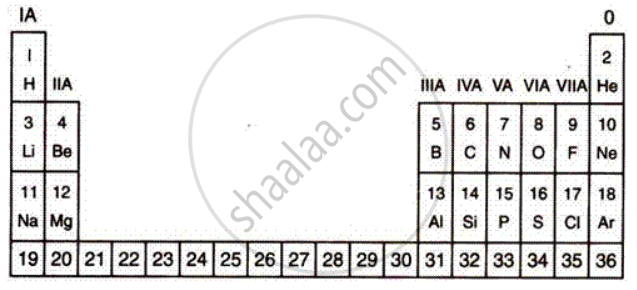
- Write the formula of the sulphate of the element with atomic number 13.
- What type of bonding will be present in the oxide of the element with atomic number 1?
- Which feature of the atomic structure accounts for the similarities in the chemical properties of the elements in group VIIA of the periodic table?
- Name the element which has the highest ionization potential.
- How many electrons are present in the valence shell of the element with atomic number 18?
- What is the name given to the energy released, when an atom in its isolated gaseous state accepts an electron to form an anion?
- What is the electronic configuration of the element in the third period which gains one electron to become an anion?
- Fill in the blanks:
The atomic size ______ as we move from left to right across the period, because the ______ increases, but the ______ remains the same.
Choose the correct answer from the choice given:
An element A belonging to Period 3 and Group II will have
Choose the most appropriate answer from the following list of oxides which fit the description.
An amphoteric oxide.
Arrange the following as per instruction given in the bracket.
Cs, Na, Li, K, Rb (increasing metallic character)
An element belongs to the third period and Group IIIA (13) of the periodic table. State: the number of valence electrons,
An element belongs to the third period and Group IIIA (13) of the periodic table. State: if it is a metal or non-metal?
Moving down in the second group, number of valence electrons ______.
Based on the group valency of element write the molecular formula of the following compound giving justification:
Oxide of first group elements.
The position of certain elements in the Modern Periodic Table is shown below:
| Group → Period ↓ |
1 | 2 | 3 to 12 | 13 | 14 | 15 | 16 | 17 | 18 |
| 1 | G | H | |||||||
| 2 | A | I | B | C | |||||
| 3 | D | E | F |
Using the above table answer the following questions giving reasons in each case:
- Which element will form only covalent compounds?
- Which element is a non-metal with valency 2?
- Which element is a metal with valency 2?
- Out of H, C, and F which has the largest atomic size?
- To which family does H, C, and F belong?
Write the electronic configuration of two elements A and B whose atomic numbers are 20 and 17 respectively. Write the molecular formula of the compound formed when element A reacts with element B. State whether this compound is acidic, basic or neutral. Give a reason to justify your answer.
Fill in the blanks from the words A to F given below’.
A: Decreases
B: Increases
C: Remains same
D: Increases by one
E: Electropositive
F: Electronegative
Across a period from left to right in the Modern Periodic Table.
No. of electron shells _________; No. of valence electrons __________: Electronegativity increases Character of elements changes from electropositive to ________.
Give a reason for the following:
A transition from metallic to non-metallic elements is seen on moving from left to right in a period of the periodic table.
