Advertisements
Advertisements
प्रश्न
Give reason for the following:
In a single fixed pulley, the velocity ratio is always more than the mechanical advantage.
Advertisements
उत्तर
In a single fixed pulley, some effort is wasted in overcoming friction between the strings and the grooves of the pulley; so the effort needed is greater than the load and hence the mechanical advantage is less than the velocity ratio.
संबंधित प्रश्न
Answer the following in short.
Explain the various functions that a machine can perform.
Name a machine to change the direction of force ?
Explain how a gear system can be used to obtain gain in speed? Given one example.
Explain how a gear system can be used to obtain gain in torque? Given one example.
In which direction does the force need to applied, when a single pulley is used with a mechanical advantage greater than one? How can you change the direction of force applied without altering its mechanical advantage? Draw a labelled diagram of the system.
A pulley system has a velocity ratio 3. Draw a diagram showing the point of application and direction of load (L), effort (E) and tension (T). It lifts a load of 150 N by an effort of 60 N. Calculate its mechanical advantage. Is the pulley system ideal? Give reason.
What is a block and tackle system of pulleys?
Give reason for the following:
The efficiency of a pulley is always less than 100%
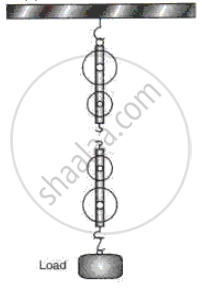
(a) Fig represents an incomplete diagram of a simple string pulley system. Copy this diagram on a new page and complete it and mark where the effort must be applied to lift the load.
(b) What is the velocity ratio of this system?
(c) If the pulley system is 80% efficient and the load is 720 N, then
(i) What effort must be applied to lift the load?
(ii) What work must be done must be done in lifting the load through a distance of 2 m using this machine?
A boy lifts a load of 40 kgf through a vertical height of 2m in 5s by using a single fixed pulley when he applies an effort of 48 kgf. Calculate:
(i) the mechanical advantage, and
(ii) the efficiency of the pulley. Why is the efficiency of the pulley is not 100%?
(iii) the energy gained by the load in 5s, and
(iv) the power developed by the boy in raising the load.
