Advertisements
Advertisements
प्रश्न
Give one example of a class I lever where the mechanical advantage is more than 1.
Advertisements
उत्तर
A shear is a class I lever with an M.A. more than 1.
संबंधित प्रश्न
State whether the following statement is True or False.
All levers are force multipliers.
Which class of lever has the mechanical advantage always more than 1? Give an example.
Which class of lever has the mechanical advantage always less than 1? Give an example.
Name the class to which the following lever belong:
a beam balance
Name the class to which the following lever belong:
a wheelbarrow
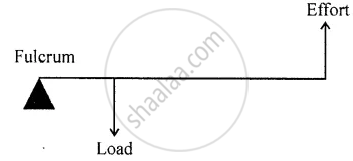
The diagram given below shows the three kinds of levers. Name the class of lever and give one example of the class.
Draw diagram to illustrate the position of fulcrum, load, and effort, of the following:
a nutcracker
Answer the following.
Name the simplest of all types of machines.
Draw a labelled diagram of a class II lever. Give one example of such a lever.
Classify the following into levers:
A door
Classify the following into levers:
A catapult
Classify the following into levers:
Wheel barrow
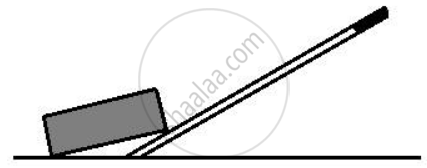
The diagram below shows a rod lifting a stone.
- Mark position of fulcrum F and draw arrows to show the directions of load L and effort E.
- What class of lever is the rod?
- Give one more example of the same class of lever stated in part (b).
Match the following:
| 1. | Class I lever | a. | Wheelbarrow |
| 2. | Class II lever | b. | Seesaw |
| 3. | Class III lever | c. | Axe |
| 4. | Wedge | d. | Hockey sick |
second-order lever ______.
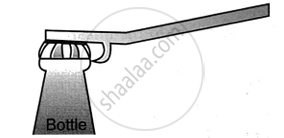
Name the class of the lever shown in the picture below:
A ______ lever will always have M.A. > 1.
Classify the following into levers:
Sugar tongs
