Advertisements
Advertisements
प्रश्न
Give one example each in which a force does (a) positive work (b) negative work, and (c) zero work.
Advertisements
उत्तर
The examples of positive, negative and zero work are as follows:
(a) Positive work - When we kick a football, it moves in the direction of the force applied and hence, the work done in this case is positive.
(b) Negative work - Work done by the frictional force on a rolling football to decrease its motion is an example of negative work, as the direction of frictional force (acting on the ball) is opposite to the direction of the football’s motion
(c) Zero work - Work done by the earth on a satellite moving around the earth is zero as the direction of the motion of the satellite is always perpendicular to the direction of the gravitational force.
APPEARS IN
संबंधित प्रश्न
Look at the activity below. Reason out whether or not work is done in the light of your understanding of the term ‘work’.
A sailboat is moving due to wind energy.
The S.I. unit of energy is .............
.A man raises a box of mass 50kg to a height of 2m in 20s, while another man raises the same box to the same height in 50s. Compare:
(i) the work done, and
(ii) the power developed by them.
Is work a scalar or a vector quantity?
How much work is done when a force of 1 N moves a body through a distance of 1 m in its own direction?
Does the earth move around the sun with a uniform velocity?
Write an expression for the work done against gravity.
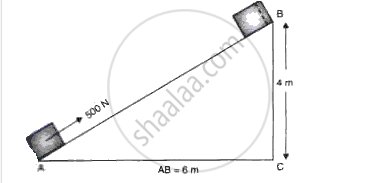
A block of mass 20 kg is pulled up a slope (fig.12) with a constant speed by applying a force of 500 N parallel to the slope. A and B are initial and final positions of the block.
(a) Calculate the work done by the force in moving the block from A and B.
(b) Calculate the potential energy gained by the block.
State the energy changes which take place when A piece of magnesium wire is burnt in a jar of oxygen.
Give an example
Chemical energy changes to heat energy.
