Advertisements
Advertisements
प्रश्न
Give a simple chemical test to distinguish between the following pair of compounds:
Acetophenone and Benzophenone
Advertisements
उत्तर
Acetophenone gives iodoform test, but benzophenone does not.

APPEARS IN
संबंधित प्रश्न
Distinguish between:
C6H5-COCH3 and C6H5-CHO
Predict the products of the following reactions :

How will you convert ethanal into the following compound?
But-2-enoic acid
Give a simple chemical test to distinguish between the following pair of compounds:
Benzoic acid and Ethyl benzoate
Give a simple chemical test to distinguish between the following pair of compounds:
Benzaldehyde and Acetophenone
Which sugar does not reduce Fehling's solution?
Acetone and acetaldehyde are differentiated by
Acetaldehyde cannot show?
Ammonical silver nitrate solution is called
What is the composition of Fehling's reagent?

Which among the above compound/s does/do not form Silver mirror when treated with Tollen's reagent?
An organic compound neither reacts with neutral ferric chloride solution nor with Fehling solution. It however, reacts with Grignard reagent and gives positive iodoform test. The compound is:
In Tollen's test for aldehyde, the overall number of electrons(s) transferred to the Tollen's reagent formula \[\ce{[Ag(NH3)2]+}\] per aldehyde group to form silver mirror is ______. (Round off to the nearest integer)
The reagent that can be used to distinguish acetophenone and benzophenone is ______.
An organic compound 'A' with the molecular formula C4H8O2 undergoes acid hydrolysis to form two compounds 'B' and 'C'. Oxidation of 'C' with acidified potassium permanganate also produces 'B'. Sodium salt of 'B' on heating with soda lime gives methane.
- Identify 'A', 'B' and 'C'.
- Out of 'B' and 'C', which will have higher boiling point? Give reason.
Benzaldehyde is obtained from Rosenmund’s reduction of:
Match List-I with List-II:
| List-I (Reaction) |
List-II (Reagents/Condition) |
||
| A. | 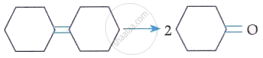 |
I. | 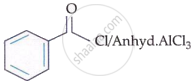 |
| B. | 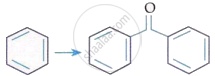 |
II. | CrO3 |
| C. | 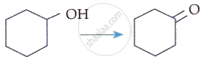 |
III. | KMnO4/KOH, Δ |
| D. | 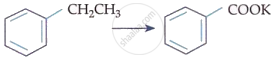 |
IV. | (i) O3 (ii) Zn-H2O |
Choose the correct answer from the options given below:
Fehling’s solution ‘A’ is ______.
