हिंदी

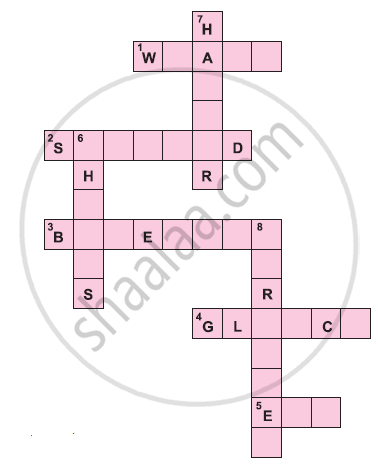
Find out the meaning of the following words by looking them up in the dictionary. Then use them in sentences of your own. challenge mystic comical courtier smearing

Advertisements
Advertisements

प्रश्न

Find out the meaning of the following words by looking them up in the dictionary. Then use them in sentences of your own.

smearing

परिभाषा
एक पंक्ति में उत्तर
Advertisements

उत्तर

Smearing: Coat or mark carelessly with grease or oil.
Before the game, Rakesh smeared his body with oil.

shaalaa.com
Reading
  क्या इस प्रश्न या उत्तर में कोई त्रुटि है?
अध्याय 3.1: Gopal and the Hilsa Fish - Working with Language [पृष्ठ ४३]

APPEARS IN

एनसीईआरटी English - Honeycomb Class 7
अध्याय 3.1 Gopal and the Hilsa Fish
Working with Language | Q 2.4 | पृष्ठ ४३

संबंधित प्रश्न

The cat and the author are very fond of each other. How has this been shown in the story? Where was the cat after the fire? Who brings it back and how?


Here's a glimpse of a naughty child whose life is full of fun and frolic . 

One of the reasons why Tom's mind had drifted away from ita secret troubles was that it bad found a new and weighty matter to interest itself about. Becky Thatcher had stopped coming to school. Tom bad struggled with his pride a few days and tried to "whistle her down the wind," but failed. He began to find himself hanging around her father's house all night and feeling very miserable. She was ill. What if she should die! There was distraction in the thought. Tom Sawyer no longer took an interest in war, nor even in piracy. The charm of life was gone; there was nothing but dreariness left. He put his hoop away, and his bat; there was no joy in them any more. His aunt was concerned. She began to try all manners of remedies on him. She was one of those people who are Infatuated with patent medicines and all new-fangled methods of producing health or mending it. She was an inveterate experimenter in these things. When something fresh in this line came out, she was in a fever, right away, to try it; not on herself, for she was never ailing, but on anybody else that came handy. 
2. She tried every remedy she could. Yet, not with standing all this, the boy grew more and more melancholy and pale and dejected. She added hot baths, sitz baths, shower baths, and plunges. The boy remained as dismal as a hearse. She began to assist the boy with a slim oatmeal diet and blister-plaster&. She calculated his capacity as she would judge and filled him up every day with quack cure-alls. 
3. Tom had become indifferent to persecution by this time. This phase filled the old lady's heart with consternation. This indifference must be broken up at any cost. Now she heard of Pain-killer for the first time. She ordered a lot at once. She tasted it and was filled with gratitude. It was simply fire in a liquid form. She dropped the water treatment and everything else, and pinned her faith on Pain-killer. She gave Tom a teaspoonful and watched with the deepest anxiety for the result. Her troubles were instantly at rest, her soul at peace again; for the 'indifference' was broken up. The boy could not have shown a wilder, heartier interest, if she had built a fire under him. 
4. Tom felt that it was time to wake up; this sort of life might be romantic enough, in his blighted condition, but it was getting to have too little sentiment and too much distracting variety about it. So he thought over various plans for relief and finally hit upon that of professing to be fond of Pain-killer. He asked for it so often that he became a nuisance and his aunt ended up by telling him to help himself and quit bothering her. If it had been Sid, she would have had no misgivings to alloy her delight; but since it was Tom, she watched the bottle clandestinely. She found that the medicine did really diminish, but it did not occur to her that the boy was mending the health of a crack in the sitting-room floor with it. 
5. One day Tom was in the act of dosing the crack when his aunt's yellow cat came along, purring, eyeing the teaspoon avariciously and begging for a taste. Tom said: "Peter, now you've asked for it, and I'll give it to you, because there ain't anything mean about me; but if you find you don't like it, you mustn't blame anybody but your own self." 
6. Tom pried his mouth open and poured down the Pain-killer. Peter sprang a couple of yards in the air, and then delivered a war-whoop and set off round and round the room, banging against furniture, upsetting flower-pots, and making general havoc. Next he rose on his hind feet and pranced around, in a frenzy of enjoyment, with his head over his shoulder and his voice proclaiming his unappeasable happiness. Then he went tearing around the house again spreading chaos and destruction in his path. Aunt Polly entered in time to see him throw a few double summersaults, deliver a final mighty hurrah, and sail through the open window, carrying the rest of the flower-pots with him. The old lady stood petrified with astonishment, peering over her glasses; Tom lay on the floor hysterical with laughter.
"Tom, what on earth ails that cat?" 
"I don't know, aunt," gasped the boy. 
7. The old lady was bending down, Tom watching, with interest emphasized by anxiety. Too late he divined her 'drift'. The handle of the telltale teaspoon was visible under the sofa. Aunt Polly took it, held it up. Tom winced, and dropped his eyes. Aunt Polly raised him by the usual handle - his ear - and cracked his head soundly with her thimble. 
"Now, sir, what did you want to treat that poor dumb beast so, for?" 
"I done it out of pity for him - because he hadn't any aunt." 
"Hadn't any aunt! -you numskull. What has that got to do with it?" 
"Heaps. Because if he'd had one, she'd a burnt him out herself! She'd a roasted his bowels out of him 'thout any more feeling than if he was a human!" 
Tom looked up in her face with just a perceptible twinkle peeping through his gravity. 
"I know you was meaning for the best, aunty, and so was I with Peter. It done him good, too. I never see him get around so-" 


'All right!' you 'll cry.'All right!' you'll say,
'But if we take the set away,
What shall we do to entertain
Our darling children?Please explain!'
We'll answer this by asking you,
'What used the darling ones to do?
'How used they keep themselves contented
Before this monster was invented?'
Have you forgotten? Don't you know?
We'll say it very loud and slow:
THEY ... USED ... TO ... READ! They'd READ and READ,
AND READ and READ, and then proceed
To READ some more. Great Scott! Gadzooks!
One half their lives was reading books!
The nursery shelves held books galore!
Books cluttered up the nursery floor!
And in the bedroom, by the bed,
More books were waiting to be read!

Read the lines given above and answer the question given below.

What should be done to keep the children occupied?


“There were three animals altogether,” he explained. “There were two goats and a cat and then there were four pairs of pigeons.”
“And you had to leave them?” I asked.
“Yes. Because of the artillery. The captain told me to go because of the artillery.” “And you have no family?” I asked, watching the far end of the bridge where a few last carts were hurrying down the slope of the bank.
“No,” he said, “only the animals I stated. The cat, of course, will be all right. A cat can look out for itself, but I cannot think what will become of the others.”
“What politics have you?” I asked.
“I am without politics,” he said. “I am seventy-six years old. I have come twelve kilometers now and I think now I can go no further.”
“This is not a good place to stop,” I said. “If you can make it, there are trucks up the road where it forks for Tortosa.”
“I will wait a while,” he said, “ and then I will go. Where do the trucks go?” “Towards Barcelona,” I told him.
“I know no one in that direction,” he said, “but thank you very much.

Read the extract given below and answer the question that follow.

Why did the old man have to leave his animals?


“So that is what you are doing out here? A marshal!” “My dear Miss Fairchild,” said ’ Easton, calmly, “I had to do something. Money has & way of taking wings unto itself, and

you know it takes money to keep step with our crowd in Washington. I saw this opening in the West, and—well, a marshalship isn’t quite as high a position as that of ambassador, but—” “The ambassador,” said the girl, warmly, “doesn’t call any more. He needn’t ever have done so. You ought to know that. And so now you are one of these dashing Western heroes, and you ride and shoot and go into all kinds of dangers. That’s different from the Washington life. You have been missed from the old crowd.” The girl’s eyes, fascinated, went back, widening a little, to rest upon the glittering handcuffs. “Don’t you worry about them, miss,” said the other man. “All marshals handcuff themselves to their prisoners to keep them from getting away. Mr. Easton knows his business.” “Will we see you again soon in Washington?” asked the girl. “Not soon, I think,” said Easton. “My butterfly days are over, I fear.”

Read the extract given below and answer the question that follow.

What does Mr Easton mean by the phrase, “My butterfly days are over, I fear.”


Write ‘True’ or ‘False’ against each of following statements.

(i) Mr. Purcell sold birds, cats, dogs and monkeys. ____

(ii) He was very concerned about the well-being of the birds and animals in his shop. _____

(iii)He was impressed by the customer who bought the two doves. _____

(iv)He was a successful shopowner, though insensitive and cold as a person. _____


The king helped the hermit in digging the beds. He even slept on the floor of the hut and lived like a simple man in the hermit’s hut. What lesson we learn from this?


Who is Mridu and with whom Mridu went to Rukku Manni’s place?


Which was the toughest part of the bicycle that the author’s friend found the toughest to fix?


What were Soapy’s hopes for the winter?


What happens when the winds blow?


Why does father ask mother to stand away?


Answer the following question. (Refer to that part of the text whose number is given against the question. This applies to the comprehension questions throughout the book.)

In what subjects did the little man need help to do Patrick’s homework? (5, 6)


Answer the following question:

Why was Rasheed upset?


The child wants to become_______________.


What was Mr Gessler’s complaint against ‘big farms’?


Who do you think Mr Nath is? Write a paragraph or two about him.


Read the following passage carefully and answer the questions that follow:

Ashamanja Babu lived in a small flat in Bhowanipore. A clerk in the registry department of Lajpat Rai Post Office, Ashamanja Babu was fortunate as he could walk to his office in seven minutes flat without having to fight his way into the buses and trains of Calcutta. He lived a rather carefree life as he was not the kind of person to sit and brood about what might have been had fate been kinder to him. On the whole, he was quite content with his lot. Two Hindi films and fish twice a week-these were enough to keep him happy. The only thing that 10 perturbed him at times was his lack of companionship. A bachelor with few friends and relatives, he often wished he had a dog to keep him company. It need not be a huge Alsatian like the one owned by the Talukdars, who lived two houses down the lane; it could be any ordinary little dog which would follow him around·morning and evening, wag its tail when he came home from work and obey his orders faithfully. Ashamanja Babu's secret desires were that he would speak to his dog in English.

'Stand up', 'Sit down', 'Shake hands' - how nice it 20 would be if his dog obeyed such commands! That would make him really happy.

On a cloudy day marked by a steady drizzle, Ashamanja Babu went to the market in Hashimara to buy some oranges. At one end of the market, beside a stunted kul tree, sat a man. As their eyes met, the man smiled. Was he a beggar? His clothes made him look like one. Ashamanja Babu noticed at least five sewn-on patches on his trousers and jacket. But the man didn't have a begging bowl. Instead, by his side was a shoe-box with a 30 little pup sticking its head out of it.

'Good morning!' said the man in English. Ashamanja Babu was obliged to return the greeting.

'Buy dog? Dog buy? Very good dog.' The man had taken the pup out of the box and had put it down on the ground. 'Very cheap. Very good. Happy dog.'
The pup shook the raindrops off its coat, looked at Ashamanja Babu and wagged its minuscule two-inch tail. Ashamanja Babu moved closer to the pup, crouched ' on the ground and stretched out his hand. The pup gave 40 his ring finger a lick with its pink tongue. Nice, friendly dog.

'How much? What price?'

'Ten rupees.'

A little haggling and the price came down to seven rupees. Ashamanja Babu paid the money, put the pup back in the shoe-box, closed the lid to save it from the drizzle, and turned homewards, forgetting all about the oranges.

  1. For each word given below choose the correct meaning (as used in the passage) from the options provided:    (2)
    1. perturbed  (line 11)
      1. frightened
      2. unsettled
      3. confused
      4. mocked
    2. stunted  (line 25)
      1. prevented from growing
      2. prepared for tricks
      3. prevented from taking action
      4. allowed to do stunts
  2. Which word in the passage means the opposite of the word 'expensive'?  (1)
    1. carefree
    2. ordinary
    3. cheap
    4. haggling
  3. Answer the following questions briefly in your own words:
    1. What kept Ashamanja Babu happy?  (2)
    2. What does this tell you about him?   (2)
    3. What is that one other thing he needed to complete his happiness?  (1)
    4. Why did Ashamanja Babu think the man was a beggar?   (2)
    5. Why did Ashamanja Babu forget about his oranges?   (2)
  4. In not more than 50 words, narrate the series of events from the time the puppy was taken out of the box till it was paid for.  (8)

“So was I once myself a swinger of birches."

What mood of the poet is captured in the above lines taken from the poem, Birches?


In the poem, The Darkling Thrush, the poet uses the words “evensong" and “carolling” to describe the thrush's song because ______.


Share
Notifications

Englishहिंदीमराठी


      Forgot password?
Use app×