Advertisements
Advertisements
प्रश्न
Find the equation of the bisector of angle A of the triangle whose vertices are A (4, 3), B (0, 0) and C(2, 3).
Advertisements
उत्तर
The vertices of triangle ABC are A (4, 3), B (0, 0) and C (2, 3).
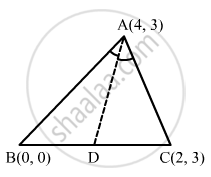
Let us find the lengths of sides AB and AC.
\[AB = \sqrt{\left( 4 - 0 \right)^2 + \left( 3 - 0 \right)^2} = 5\]
\[AC = \sqrt{\left( 4 - 2 \right)^2 + \left( 3 - 3 \right)^2} = 2\]
We know that the internal bisector AD of angle BAC divides BC in the ratio AB : AC i.e. 5 : 2
\[\therefore D \equiv \left( \frac{2 \times 0 + 5 \times 2}{5 + 2}, \frac{2 \times 0 + 5 \times 3}{5 + 2} \right) = \left( \frac{10}{7}, \frac{15}{7} \right)\]
Thus, the equation of AD is
\[y - 3 = \frac{3 - \frac{15}{7}}{4 - \frac{10}{7}}\left( x - 4 \right)\]
\[ \Rightarrow y - 3 = \frac{1}{3}\left( x - 4 \right)\]
\[ \Rightarrow x - 3y + 5 = 0\]
