Advertisements
Advertisements
प्रश्न
Find the distances between the following point.
P(–6, –3), Q(–1, 9)
Advertisements
उत्तर
P(–6, –3), Q(–1, 9)
\[PQ = \sqrt{\left( - 6 - \left( - 1 \right) \right)^2 + \left( - 3 - 9 \right)^2}\]
\[ = \sqrt{25 + 144}\]
\[ = \sqrt{169}\]
\[ = 13\]
APPEARS IN
संबंधित प्रश्न
If the point A(0, 2) is equidistant from the points B(3, p) and C(p, 5), find p. Also, find the length of AB.
If the point P(2, 2) is equidistant from the points A(–2, k) and B(–2k, –3), find k. Also, find the length of AP.
Name the type of quadrilateral formed, if any, by the following point, and give reasons for your answer:
(−3, 5), (3, 1), (0, 3), (−1, −4)
Show that the points A (1, –2), B (3, 6), C (5, 10) and D (3, 2) are the vertices of a parallelogram.
Find the distance between the points:
A(7, –4) and B(–5, 1)
Find the distance between the points `A((-8)/5, 2)` and `B(2/5, 2)`.
Find the distance between the following pair of points.
R(0, -3), S(0, `5/2`)
Find the distance of the following point from the origin :
(6 , 8)
Find the coordinate of O , the centre of a circle passing through A (8 , 12) , B (11 , 3), and C (0 , 14). Also , find its radius.
A(2, 5), B(-2, 4) and C(-2, 6) are the vertices of a triangle ABC. Prove that ABC is an isosceles triangle.
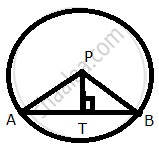
Point P (2, -7) is the center of a circle with radius 13 unit, PT is perpendicular to chord AB and T = (-2, -4); calculate the length of: AT
Calculate the distance between A (7, 3) and B on the x-axis whose abscissa is 11.
Find the distance of the following points from origin.
(a cos θ, a sin θ).
Show that the points (a, a), (-a, -a) and `(-asqrt(3), asqrt(3))` are the vertices of an equilateral triangle.
Find distance CD where C(–3a, a), D(a, –2a).
A circle drawn with origin as the centre passes through `(13/2, 0)`. The point which does not lie in the interior of the circle is ______.
The distance between the points A(0, 6) and B(0, –2) is ______.
The point A(2, 7) lies on the perpendicular bisector of line segment joining the points P(6, 5) and Q(0, – 4).
The centre of a circle is (2a, a – 7). Find the values of a if the circle passes through the point (11, –9) and has diameter `10sqrt(2)` units.
Read the following passage:
|
Alia and Shagun are friends living on the same street in Patel Nagar. Shagun's house is at the intersection of one street with another street on which there is a library. They both study in the same school and that is not far from Shagun's house. Suppose the school is situated at the point O, i.e., the origin, Alia's house is at A. Shagun's house is at B and library is at C. |
Based on the above information, answer the following questions.
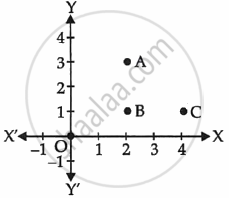
- How far is Alia's house from Shagun's house?
- How far is the library from Shagun's house?
- Show that for Shagun, school is farther compared to Alia's house and library.
OR
Show that Alia’s house, shagun’s house and library for an isosceles right triangle.
