Advertisements
Advertisements
प्रश्न
Fill in the blanks from the words A to F given below.
A: Decreases
B: Increases
C: Remains same
D: Increases by one
E: Electropositive
F: Electronegative
Down a group in the Modern Periodic Table.
No. of electron shells __________; No. of valence electrons ________; Electronegativity ________ Character of elements changes from _________ to ____________.
Advertisements
उत्तर
Down a group in the Modern Periodic Table.
No. of electron shells increases by one; No. of valence electrons remains same; Electronegativity decreases Character of elements changes from electronegative to electropositive.
APPEARS IN
संबंधित प्रश्न
Given below are some elements of the modern periodic table. Atomic number of the element is given in parentheses.
A(4), B(9), C(14), D(19), E(20)
(a) Select the element that has one electron in the outermost shell. Also, write the electronic configuration of this element.
(b) Which two elements amongst these belong to the same group? Give reasons for your answer.
(c) Which two elements amongst these belong to the same period? Which one of the two has bigger atomic radius?
An element 'X' belong to 3rd period and group 13 of the Modern Periodic Table.
(a) Determine the valence electrons and the valency of 'X'.
(b) Molecular formula of the compound formed when 'X' reacts with an element 'Y' (atomic number = 8).
(c) Write the name and formula of the compound formed when 'X' combines with chlorine
The electronic configuration of the atom of an element X is 2, 8, 4. In modern periodic table, the element X is places in :
(a) 2nd group
(b) 4th group
(c) 14th group
(d) 8th group
How do the following change on moving from left to right in a period of the periodic table?
Give examples in support of your answer.
atomic structure (electron arrangements) ?
Explain, the statement 'In each period, the atomic radii gradually decrease with increase in atomic number'. Give one example to justify your answer.
Atomic number of an element is 16. State
- the period to which it belongs
- the number of valence electrons
- whether it is a metal or non-metal
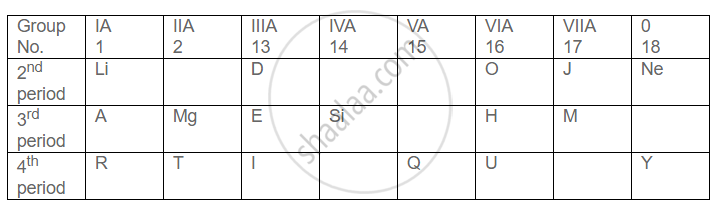
In the above table, H does not represent hydrogen.Some elements are given in their own symbol and position in the periodic table while others are shown with a letter. With refrence to the table answer the following questions.
1. Identify the most electronegative element.
2. Identify the most reactive element of Group I.
3. Identify the element from Period 3 with least atomic size.
4. How many valence electrons are present in Q?
5. Which element from group 2 would have the least ionisation energy?
6. Identify the noble gas of the fourth period.
7. In the compound between A and H, what type of bond would be formed and give its molecular formula.
The position of elements A, B, C, D and E in the periodic table are shown below:
|
Group 1 |
Group 2 |
Group 17 |
Group 18 |
|
|
|
|
D |
|
|
B |
C |
|
|
A |
|
|
E |
Which is larger in size (i) D or E (ii) B or C
An element belongs to the third period and Group IIIA (13) of the periodic table. State: the name of the element.
Name or state following with reference to the element of the first three periods of the periodic table.
A metal in period 3 having valency 3.
