Advertisements
Advertisements
प्रश्न
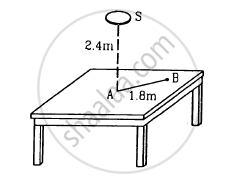
Figure shows a small diffused plane source S placed over a horizontal table-top at a distance of 2.4 m with its plane parallel to the table-top. The illuminance at the point Adirectly below the source is 25 lux. Find the illuminance at a point B of the table at a distance of 1.8 m from A.
Advertisements
उत्तर
Let x be the distance moved.
Let the illuminance of the candle and the lamp at a distance 1 m be IC and ILrespectively. According to question,
`E=I_L/(0.8)^2=I_c/(0.2)^2`
`rArr I_L/I_c=16`
Again after the wrapping the paper around
`49/100I_L/(0.8+x)^2=I_c/(0.2)^2`
Either,
x = -0.24
Or,
x = -1.36 this value is not acceptable because it is more than 0.8
so, x = 0.24m (-ve sign denotes distance is to be decreased)
x = 24cm
APPEARS IN
संबंधित प्रश्न
What is the luminous flux of a source emitting radio waves?
Light is incident normally on a small plane surface. If the surface is rotated by an angle of 30° about the incident light, does the illuminance of the surface increase, decreases or remain same? Does your answer change if the light did not fall normally on the surface?
A bulb is hanging over a table. At which portion of the table is the illuminance maximum? If a plane mirror is placed above the bulb facing the table, will the illuminance on the table increase?
Why is the luminous efficiency small for a filament bulb as compared to a mercury vapour lamp?
The yellow colour has a greater luminous efficiency as compared to the other colours. Can we increase the illuminating power of a white light source by putting a yellow plastic paper around this source?
An electric bulb is hanging over a table at a height of 1 m above it. The illuminance on the table directly below the bulb is 40 lux. The illuminance at a point on the table 1 m away from the first point will be about ___________ .
The intensity produced by a long cylindrical light source at a small distance r from the source is proportional to _________ .
A point source of light moves in a straight line parallel to a plane table. Consider a small portion of the table directly below the line of movement of the source. The illuminance at this portion varies with its distance r from the source as ___________ .
A room is illuminated by an extended source. The illuminance at a particular portion of a wall can be increased by
(a) moving the source
(b) rotating the source
(c) bringing some mirrors in proper positions
(d) changing the colour of the source.
A photographic plate records sufficiently intense lines when it is exposed for 12 s to a source of 10 W. How long should it be exposed to a 12 W source radiating the light of same colour to get equally intense lines?
Using figure, find the relative luminosity of wavelength (a) 480 nm, (b) 520 nm (c) 580 nm and (d) 600 nm.
The illuminance of a small area changes from 900 lumen m−2 to 400 lumen m−2 when it is shifted along its normal by 10 cm. Assuming that it is illuminated by a point source placed on the normal, find the distance between the source and the area in the original position.
A point source emitting light uniformly in all directions is placed 60 cm above a table-top. The illuminance at a point on the table-top, directly below the source, is 15 lux. Find the illuminance at a point on the table-top 80 cm away from the first point.
A student is studying a book placed near the edge of a circular table of radius R. A point source of light is suspended directly above the centre of the table. What should be the height of the source above the table so as to produce maximum illuminance at the position of the book?
An electric lamp and a candle produce equal illuminance at a photometer screen when they are placed at 80 cm and 20 cm from the screen respectively. The lamp is now covered with a thin paper which transmits 49% of the luminous flux. By what distance should the lamp be moved to balance the intensities at the screen again?
Photo diodes are used to detect ______.
