Advertisements
Advertisements
प्रश्न
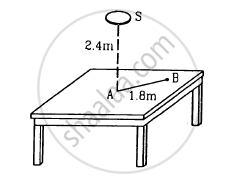
Figure shows a small diffused plane source S placed over a horizontal table-top at a distance of 2.4 m with its plane parallel to the table-top. The illuminance at the point Adirectly below the source is 25 lux. Find the illuminance at a point B of the table at a distance of 1.8 m from A.
Advertisements
उत्तर
Let x be the distance moved.
Let the illuminance of the candle and the lamp at a distance 1 m be IC and ILrespectively. According to question,
`E=I_L/(0.8)^2=I_c/(0.2)^2`
`rArr I_L/I_c=16`
Again after the wrapping the paper around
`49/100I_L/(0.8+x)^2=I_c/(0.2)^2`
Either,
x = -0.24
Or,
x = -1.36 this value is not acceptable because it is more than 0.8
so, x = 0.24m (-ve sign denotes distance is to be decreased)
x = 24cm
APPEARS IN
संबंधित प्रश्न
What is the luminous flux of a source emitting radio waves?
The luminous flux of a 1 W sodium vapour lamp is more than that of a 10 kW source of ultraviolet radiation. Comment.
An electric bulb is hanging over a table at a height of 1 m above it. The illuminance on the table directly below the bulb is 40 lux. The illuminance at a point on the table 1 m away from the first point will be about ___________ .
Light from a point source falls on a screen. If the separation between the source and the screen is increased by 1%, the illuminance will decrease (nearly) by ____________ .
A photographic plate placed a distance of 5 cm from a weak point source is exposed for 3 s. If the plate is kept at a distance of 10 cm from the source, the time needed for the same exposure is _____________ .
Mark out the correct options.
(a) Luminous flux and radiant flux have same dimensions.
(b) Luminous flux and luminous intensity have same dimensions.
(c) Radiant flux and power have same dimensions.
(d) Relative luminosity is a dimensionless quantity.
A source emits 45 joules of energy in 15 s. What is the radiant flux of the source?
Using figure, find the relative luminosity of wavelength (a) 480 nm, (b) 520 nm (c) 580 nm and (d) 600 nm.
The luminous flux of a monochromatic source of 1 W is 450 lumen watt−1. Find the relative luminosity at the wavelength emitted.
A source emits light of wavelengths 555 nm and 600 nm. The radiant flux of the 555 nm part is 40 W and of the 600 nm part is 30 W. The relative luminosity at 600 nm is 0.6. Find (a) the total radiant flux, (b) the total luminous flux, (c) the luminous efficiency.
A light source emits monochromatic light of 555 nwavelengthm. The source consumes 100 W of electric power and emits 35 W of radiant flux. Calculate the overall luminous efficiency.
A source emits 31.4 W of radiant flux distributed uniformly in all directions. The luminous efficiency is 60 lumen watt−1. What is the luminous intensity of the source?
The illuminance of a small area changes from 900 lumen m−2 to 400 lumen m−2 when it is shifted along its normal by 10 cm. Assuming that it is illuminated by a point source placed on the normal, find the distance between the source and the area in the original position.
A point source emitting light uniformly in all directions is placed 60 cm above a table-top. The illuminance at a point on the table-top, directly below the source, is 15 lux. Find the illuminance at a point on the table-top 80 cm away from the first point.
Light from a point source falls on a small area placed perpendicular to the incident light. If the area is rotated about the incident light by an angle of 60°, by what fraction will the illuminance change?
Two light sources of intensities 8 cd and 12 cd are placed on the same side of a photometer screen at a distance of 40 cm from it. Where should a 80 cd source be placed to balance the illuminance?
Light travels through a glass plate of thickness t and having a refractive index μ. If c is the velocity of light in vacuum, the time taken by the light to travel this thickness of glass is ______.
