Advertisements
Advertisements
प्रश्न
Explain why Grignard reagents should be prepared under anhydrous conditions?
Advertisements
उत्तर
Grignard reagents are very reactive. In the presence of moisture, they react to give alkanes.
\[\ce{\underset{reagent}{\underset{Grigrard}{\overset{\delta-}{R} \overset{\delta +}{M}g \overset{\delta -}{X}}} + H2O -> \underset{Alkane}{R - H} + Mg (OH) X}\]
Therefore, Grignard reagents should be prepared under anhydrous conditions.
APPEARS IN
संबंधित प्रश्न
Identify A, B, C, D, E, R and R1 in the following:
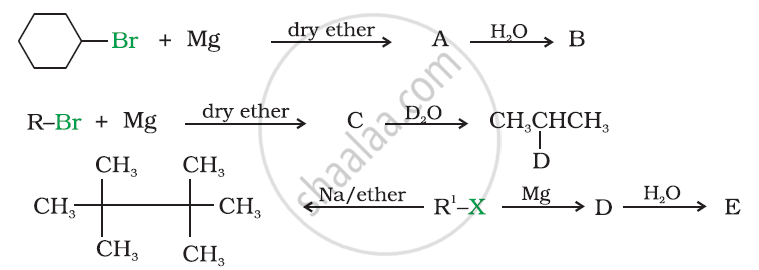
Write the structure of the major organic product in the following reaction:
\[\ce{C6H5ONa + C2H5Cl ->}\]
What happens when methyl bromide is treated with sodium in the presence of dry ether?
Which of the following alkyl halides is used as a methylating agent?
Why is it necessary to avoid even traces of moisture during the use of a Grignard reagent?
Reaction of Grignard reagent with aromatic aldehyde and subsequent aqueous treatment produces
\[\ce{R - CH2 - CCl2 - R ->[Peagent] R - C ≅ C - R}\]. The reagent is:-
 A product (1) of above reaction is:-
Grignard reagent shows addition on
The product formed in the first step of the reaction
\[\begin{array}{cc}
\ce{Br}\phantom{......}\\
|\phantom{.......}\\
\ce{CH3-CH2-CH-CH2-CH-CH3}\\
\phantom{...............}|\\
\phantom{................}\ce{Br}
\end{array}\]
with excess Mg/Et2O(Et = C2H5) is:
Explain why Grignard reagents should be prepared under anhydrous conditions.
Explain why Grignard reagents should be prepared under anhydrous conditions?
Explain why Grignard reagents should be prepared under anhydrous conditions?
Explain why Grignard reagents should be prepared under anhydrous conditions?
Explain why Grignard reagents should be prepared under anhydrous conditions?
Explain why Grignard reagents should be prepared under anhydrous conditions?
