Advertisements
Advertisements
प्रश्न
Explain why, the galvanised iron article is protected against rusting even if the zinc layer is broken.
Advertisements
उत्तर
The galvanised iron-zinc oxide layer coating on iron objects prevents zinc and iron under it from corrosion. This happens because zinc is more reactive than iron. If the zinc layer is broken, zinc, being more reactive, gets oxidised before iron and prevents its corrosion.
APPEARS IN
संबंधित प्रश्न
What is an alloy?
Give two examples of alloys with their chemical composition.
Name any three objects (or structures) which are gradually damaged by the corrosion of iron and steel.
State two conditions for the rusting of iron.
Name two metals which resist corrosion due to the formation of a thin, hard and impervious layer of oxide on their surface.
Name an alloy of copper. State its chemical composition and any one use.
Write scientific reasons.
Lemon or tamarind is used for cleaning copper vessels turned greenish.
Give reason.
A wooden article should be polished.
Give reason.
Copper and brass utensils should be tinned.
State whether the statement given below is true or false. If false write the correct statement.
Either oxygen or moisture is essential for rusting.
Observe the following picture and answer the following questions:
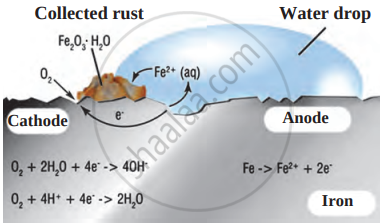
- What is rust?
- Write the chemical formula of rust.
- Write the reaction of oxidation of iron at the anode.
- Write the reaction of oxidation of iron at the cathode.
- What is corrosion?
Find the odd one out and give its explanation.
Write the name.
An alloy of copper and tin-
Write scientific reason.
Anodization method is useful for prevention of the corrosion of the aluminium.
What is rust?
Which among the following alloys contain mercury as one of its constituents?
Alloys are homogeneous mixtures of a metal with a metal or non-metal. Which among the following alloys contain non-metal as one of its constituents?
Generally, when metals are treated with mineral acids, hydrogen gas is liberated but when metals (except Mn and Mg), treated with HNO3, hydrogen is not liberated, why?
Iron pillar near the Qutub Minar in Delhi is famous for the following facts. Which of these facts is responsible for its long stability?
Explain the following:
Bubbles are produced when acetic acid is added to a solution of sodium hydrogencarbonate.
