Advertisements
Advertisements
प्रश्न
Explain what is observed when an electric current is passed through a colloidal sol?
What is observed when an electric current is passed through a colloidal solution?
Advertisements
उत्तर
The colloidal particles are charged and carry either a positive or negative charge. The dispersion medium carries an equal and opposite charge. This makes the whole system neutral. Under the influence of an electric current, the colloidal particles move towards the oppositely charged electrode. When they come in contact with the electrode, they lose their charge and coagulate.
APPEARS IN
संबंधित प्रश्न
Give reasons for the following observations:
Brownian movement provides stability to the colloidal solution.
Out of MgCl2 and AlCl3, which one is more effective in causing coagulation of negatively charged sol and why?
Define the following term : Brownian movement
Explain the terms Coagulation
Explain the terms Dialysis
What happens when persistent dialysis of a colloidal solution is carried out?
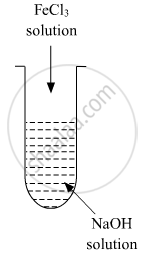
A colloidal sol is prepared by the given method in the figure. What is the charge on hydrated ferric oxide colloidal particles formed in the test tube? How is the sol represented?
What happens when a lyophilic sol is added to a lyophobic sol?
(i) Lyophobic sol is protected.
(ii) Lyophilic sol is protected.
(iii) Film of lyophilic sol is formed over lyophobic sol.
(iv) Film of lyophobic sol is formed over lyophilic sol.
How does it become possible to cause artificial rain by spraying silver iodide on the clouds?
Assertion: An ordinary filter paper impregnated with collodion solution stops the flow of colloidal particles.
Reason: Pore size of the filter paper becomes more than the size of colloidal particle.
Assertion: Coagulation power of Al3+ is more than Na+.
Reason: Greater the valency of the flocculating ion added, greater is its power to cause precipitation (Hardy Schulze rule).
Give reason for the following:
Lyophilic colloidal solutions are more stable than lyophobic colloidal solutions.
What is Gold number?
Which of the following is used for removing change on colloidal solution?
The right option for the statement “Tyndall effect is exhibited by”, is:
Define coagulation.
What is electrophoresis?
The conditions given below are in the context of observing Tyndall effect in colloidal solutions:
- The diameter of the colloidal particles is comparable to the wavelength of light used.
- The diameter of the colloidal particles is much smaller than the wavelength of light used.
- The diameter of the colloidal particles is much larger than the wavelength of light used.
- The refractive indices of the dispersed phase and the dispersion medium are comparable.
- The dispersed phase has a very different refractive index from the dispersion medium.
Choose the most appropriate conditions from the options given below:
In order to cause coagulation of 100 ml Arsenious sulphide sol 111.7 mg of 2 M NaCl solution is used, the coagulation value of NaCl will be ______.
