Advertisements
Advertisements
प्रश्न
Explain the Term: Glomerulus
Advertisements
उत्तर
Glomerulus: A single afferent arteriole of the renal artery breaks up into a number of capillary branches to form the glomerulus. The blood in the glomerulus is subjected to higher pressure since the diameter of the afferent arteriole is wider than that of the efferent arteriole that leaves the glomerulus, so ultra-filtration takes place.
संबंधित प्रश्न
The diagram given alongside is that of a structure present in a human kidney:
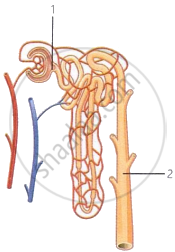
Study the same and answer the questions that follow:
- Name the structure represented in the diagram.
- What is the liquid entering part ‘1’ called?
Name two substances present in this liquid that are reabsorbed in the tubule - What is the fluid that comes to part ‘2’ called? Name the main nitrogenous waste in it.
- Mention the three main steps involved in the formation of the fluid mentioned in (c) above.
- Name the substance which may be present in the fluid in part ‘2’ if a person suffers from Diabetes mellitus
What do kidneys excrete?
Differentiate between the following pairs of term :
Renal cortex and renal medulla
Differentiate between the following pairs of term :
Renal pelvis and renal papilla
Study the diagram given alongside and then answer the question that follow:
Name the region in the kidney where the above structure is present?
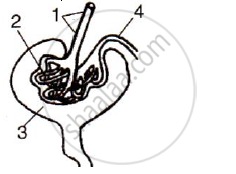
Choose the correct answer:
What happens if one kidney is removed from the body of human being?
Label the diagram given below :

Study the diagram given below and then answer the questions that follow:
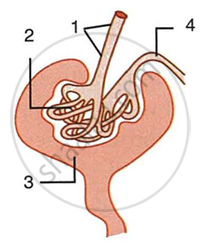 |
- Name the region in the kidney where the above structure is present?
- Name the parts labelled 1, 2, 3 and 4.
- Name the stages involved in the formation of urine.
- What is the technical term given to the process occurring in 2 and 3? Briefly describe the process.
Choose the correct option.
The minor calyx _______.
In a person the tubule part of the nephron is not functioning at all. What will its effect be on urine formation?
