Advertisements
Advertisements
प्रश्न
Explain the term ‘centre of gravity’ of a body.
Advertisements
उत्तर
A body can be considered to be made up of a number of particles, each particle has weight ‘W’. Weight of all these particles acts vertically downward and can be replaced by a single resultant force. This force passes through a fixed point. ‘G’ which is a point where the algebraic sum of moments of weight of all the particles is zero and is called the centre of gravity of the body.
Thus we can define ‘CG’ as ‘the point through which the weight of the body acts irrespective of the position of the body.’
संबंधित प्रश्न
What is the position of the centre of gravity of a cylinder?
A square cardboard is suspended by passing a pin through a narrow hole at its one corner. Draw a diagram to show its rest position. In the diagram, mark the point of suspension by the letter S and the centre of gravity by the letter G.
Explain how you will determine experimentally the position of the centre of gravity for a triangular lamina (or a triangular piece of cardboard).
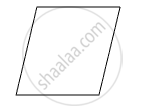
Following Fig shows piece of cardboard of uniform thickness cut into different shapes. Draw two lines to indicate the position of centre of gravity G.
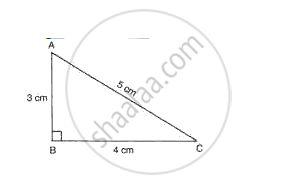
A right-angled triangle cardboard piece is placed as shown in fig. 7. Redraw the diagram showing the relative position of the vertices of the triangle when it is suspended by a pin from the hole A. Explain why the position changes?
Where does the position of centre of gravity lie for a circular lamina?
Can the CG be situated outside the material of the body? Give an example.
A boy of mass 40 kg runs up a height of 30 steps, each 20 cm high. Find:
(i) The force of gravity acting on the boy.
(ii) The work done by the boy against gravity. (Take g = 9.8 ms−2)
If mean radius of earth is R, its angular velocity is ro and the acceleration due to gravity at the surface of the earth is g, then the cube of the radius of the orbit of satellite will be ____________.
