Advertisements
Advertisements
प्रश्न
Explain the determination of unknown resistance using meter bridge.
Advertisements
उत्तर
The meter bridge is another form of Wheatstone’s bridge. It consists of a uniform manganin wire AB of one meter length. This wire is stretched along a meter scale on a wooden board between two copper strips C and D. Between these two copper strips another copper strip E is mounted to enclose two gaps G1 and G2 An unknown resistance P is connected in G1 and a standard resistance Q is connected in G2.
A jockey (conducting wire) is connected to the terminal E on the central copper strip through a galvanometer (G) and a high resistance (HR). The exact position of jockey on the wire can be read on the scale. A Lechlanche cell and a key (K) are connected across the ends of the bridge wire.

Meter bridge
The position of the jockey on the wire is adjusted so that the galvanometer shows zero deflection. Let the point be J. The lengths AJ and JB of the bridge wire now replace the resistance R and S of the Wheatstone’s bridge. Then
`"P"/"Q" = "R"/"S" = ("R"' *"AJ")/("R"'*"JB")` ....(1)
where R’ is the resistance per unit length of wire
`"P"/"Q" = "AJ"/"JB" = l_1/l_2` ....(2)
P = Q `l_1/l_2` ....(3)
The bridge wire is soldered at the ends of the copper strips. Due to imperfect contact, some resistance might be introduced at the contact. These are called end resistances. This error can be eliminated, if another set of readings are taken with P and Q interchanged and the average value of P is found.
To find the specific resistance of the material of the wire in the coil P, the radius r and length l of the wire is measured. The specific resistance or resistivity r can be calculated using the relation.
Resistance = ρ - `l/"A"`
By rearranging the above equation, we get
ρ = Resistance `xx "A"/l`
If P is the unknown resistance, equation (4) becomes
ρ = P`(pi"r"^2)/l`
APPEARS IN
संबंधित प्रश्न
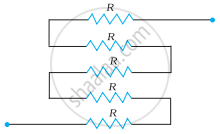
Determine the equivalent resistance of networks shown in Fig.
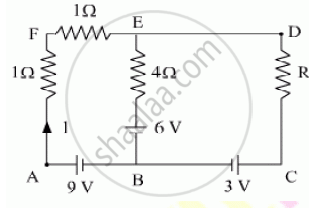
Using Kirchhoff’s rules determine the value of unknown resistance R in the circuit so that no current flows through 4 Ω resistance. Also find the potential difference between A and D.
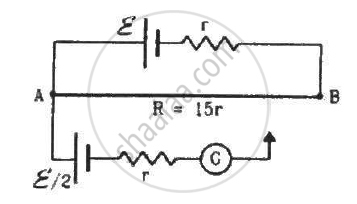
Consider the potentiometer circuit as arranged in the figure. The potentiometer wire is 600 cm long. (a) At what distance from the point A should the jockey touch the wire to get zero deflection in the galvanometer? (b) If the jockey touches the wire at a distance of 560 cm from A, what will be the current in the galvanometer?
State Kirchhoff ’s voltage rule.
A potentiometer wire has a length of 4 m and resistance of 20 Ω. It is connected in series with resistance of 2980 Ω and a cell of emf 4 V. Calculate the potential along the wire.
What is the advantage of using thick metallic strips to join wires in a potentiometer?
Who gave Kirchhoff's laws?
Which mathematical form represents Kirchhoff's Current Law using an algebraic sum of currents?
Which pair of equations expresses the loop relationship for cells and resistors?
What is emf?
