Advertisements
Advertisements
प्रश्न
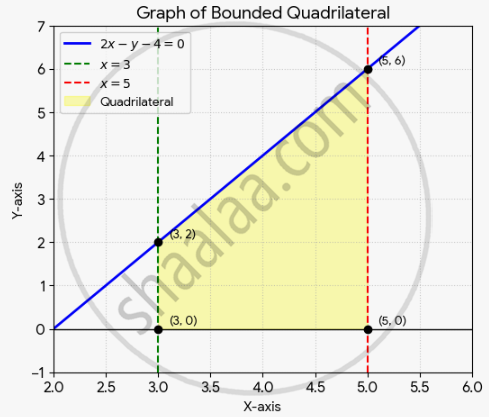
Draw the graph of the equations x = 3, x = 5 and 2x – y – 4 = 0. Also, find the area of the quadrilateral formed by the lines and the x-axis.
Advertisements
उत्तर
1. Visualizing the graph
The region bounded by the three lines and the x-axis (y = 0) forms a trapezoid (quadrilateral) with vertical boundaries at x = 3 and x = 5.
2. Finding the vertices of the quadrilateral
To locate the exact boundaries, find where the lines intersect each other and the x-axis (y = 0):
Line 1 (x = 3): A vertical line passing through x = 3. It intersects the x-axis at (3, 0).
Line 2 (x = 5): A vertical line passing through x = 5. It intersects the x-axis at (5, 0).
Line 3 (2x – y – 4 = 0 → y = 2x – 4):
At x = 3: y = 2(3) – 4 = 2 → Intersection point is (3, 2).
At x = 5: y = 2(5) – 4 = 6 → Intersection point is (5, 6).
The four vertices of the quadrilateral are (3, 0), (5, 0), (5, 6) and (3, 2).
3. Calculating the Area
Since the lines x = 3 and x = 5 are both vertical, they are parallel to each other. This means the quadrilateral is a trapezium.
Using the area formula for a trapezium:
Area = `1/2 xx ("Sum of parallel sides") xx ("Distance between them")`
Length of parallel side 1 (height at x = 3): 2 – 0 = 2 units
Length of parallel side 2 (height at x = 5): 6 – 0 = 6 units
Distance between parallel sides (width along x-axis): 5 – 3 = 2 units
Area = `1/2 xx (2 + 6) xx 2`
= 8 sq. units
