Advertisements
Advertisements
प्रश्न
Advertisements
उत्तर
APPEARS IN
संबंधित प्रश्न
Which of the organs perform the following function in humans?
Absorption of water
Where is digested food absorbed into blood in human body?
Which of the following are the correct functions of two components of pancreatic juice trypsin and lipase?
Study the diagram given below and then answer the question that follows:
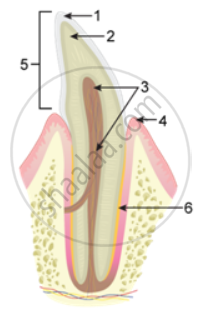
Name the parts labelled 1, 2, 3, 4, 5 and 6.
Put a tick (✓) against the most appropriate alternative in the following statement.
The teeth which help in tearing the food are the:
Fill in the blank.
The _______ is a common opening of food pipe and windpipe
Name the types of teeth seen in humans.
Write true or false for the below statement. Rewrite the false statements correctly.
All the absorbed nutrients are immediately required by the body.
Write short answers
What is ingestion?
Write short answers
Write the names of three enzymes which are found in pancreatic juice.
State one difference in nutrition: Parasite and Saprophyte
Sketch and label a diagram of the digestive system and describe it in your own words.
What bodily needs or sensations do you become aware of even though you are reading a book?
Use your brain power!
Why do we sometimes choke suddenly while eating?
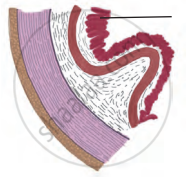
Observe the diagram. This is the histological structure of the stomach. Identify and comment on the significance of the layer marked by an arrow.
The process by which the body removes waste is called ______.
Which sphincter guards the opening of the hepato-pancreatic duct?
The exit of unabsorbed food material is regulated by ____________.
______ is a major organ for the digestion of food materials.
