Advertisements
Advertisements
प्रश्न
Do you think Mr Gessler was a failure as a bootmaker or as a competitive businessman?
Advertisements
उत्तर
Mr Gessler was successful as a bootmaker because his customers were immensely satisfied with the boot he made. This perfectly fit them and lasted long. Yes, he was a failure as a competitive businessman. He didn’t have money like the big firms so couldn’t invest on advertisements. He lost his business to them. He took time in delivering the boots because he made them alone. He lost his customers because of the delay in delivery. He worked hard, striving for long hours. Whatever, he earned went on paying the rent for his shop and for buying leathers. He spent days of great penury.
संबंधित प्रश्न
Answer these question in a few words or a couple of sentence.
What do you think a telebook is?
Thinking about the Text
On the following map mark out the route, which the author thought of but did not take, to Delhi.
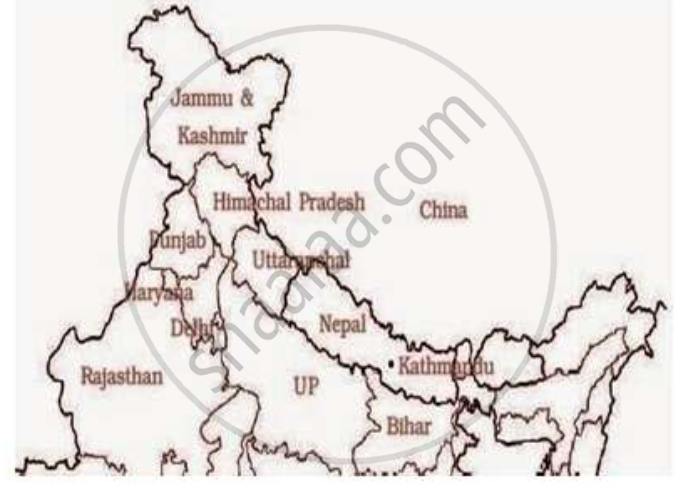
Thinking about the Text
Answer these question.
A mystery I propose to explain.” What is the mystery the speaker proposes to explain?
Go to the local library or talk to older persons in your locality and find legends in your own language. Tell the class these legends.
Some are like fields of sunlit corn,
Meet for a bride on her bridal morn,
Some, like the flame of her marriage fire,
Or, rich with the hue of her heart's desire,
Tinkling,luminous,tender, and clear,
Like her bridal laughter and bridal tear.
Read the lines given above and answer the question that follow.
Besides visual imagery the poet also uses auditory imagery.Pick out the lines.
Of the seven hundred villages dotting the map of India, in which the majority of India’s five hundred million live, flourish and die, Kritam was probably the tiniest, indicated on the district survey map by a microscopic dot, the map being meant more for the revenue official out to collect tax than for the guidance of the motorist, who in any case could not hope to reach it since it sprawled far from the highway at the end of a rough track furrowed up by the iron-hooped wheels of bullock carts. But its size did not prevent its giving itself the grandiose name Kritam, which meant in Tamil coronet or crown on the brow of the subcontinent. The village consisted of fewer than thirty houses, only one of them built from brick and cement and painted a brilliant yellow and blue all over with
gorgeous carvings of gods and gargoyles on its balustrade, it was known as the Big House. The other houses, distributed in four streets, were generally of bamboo thatch, straw, mud and other unspecified material. Muni’s was the last house in the fourth street, beyond which stretched the fields. In his prosperous days Muni had owned a flock of sheep and goats and sallied forth every morning driving the flock to the highway a couple of miles away.
Read the extract given below and answer the question that follow.
Describe Muni’s prosperous days.
The village consisted of less than thirty houses, only one of them built with brick and cement. Painted a brilliant yellow and blue all over with gorgeous carvings of gods and gargoyles on its balustrade, it was known as the Big House. The other houses, distributed in four streets, were generally of bamboo thatch, straw, mud, and other unspecified material. Muni’s was the last house in the fourth street, beyond which stretched the fields. In his prosperous days Muni had owned a flock of forty sheep and goats and sallied forth every morning driving the flock to the highway a couple of miles away.
Read the extract given below and answer the question that follow.
What did Muni’s wife cook for him in the morning? How did she cook it?
With references to George Orwell's Tlie Animd Fann', answer the following questions :
(i) Who wrote the poem 'Comrade Napoleon'?
How did Napoleon show his approval of the poem?
(ii) What precautions were taken to ensure Napoleon'?
(iii) What single commandment replaced the seven commandments on Aninzal Farin? Mention some of the changes that the animals noticed in the behavior of the pigs after the new, commandment had been put up.
The crocodile lay on the bank of the Limpopo river. Golu thought it was
Complete the following sentence.
The teacher played a few notes on his violin, and Lalli____________________________________.
What do you know about Golu?
Do you think the man would ever come back to pick up the watch?
Narrate the story of the friendship between the monkey and the crocodile in about 80 words.
Fans don’t talk, but it is possible to imagine that they do. What is it, then, that sounds like the fan’s chatter?
Read the following passage and do the exercises that follow. Then complete the family tree of dogs given on the facing page.
The Dog Family
The dog family is one of the 11 families that make up the Carnivores, a large group of intelligent, flesh-eating, backboned animals. In this group are such varied animals as bears, pandas, raccoons, cats, hyenas, and even seal. The dog or canine family has many wild species like wolves, foxes, coyotes, jackals, and wild dogs. The dog is the only domesticated member of the canine family though now and then someone tames a wolf, fox or coyote as a pet. All members of the dog family are descendants of a wolf-like animal which lived about 15 million years ago. From this distant ancestor, the true dogs gradually developed. But nobody knows the exact ancestor of the modern domestic dog.
Several wild dogs look and behave like domestic dogs. The dingo or wild dog of Australia is one of these. It is possible that the dingo was a tamed dog brought to Australia long ago which then ran wild. Dogs were the first animals tamed by humans — perhaps 20,000 years ago. Tamed dogs were brought from Asia to the New World 5,000 or more years ago. Dogs were first used for hunting.
Find the opposites of these words in the text above.
(i) ancestor _________
(ii) wild t _ m _
(iii) ancient _________
(iv) near d _______ t
(v) suddenly gr ___________
Complete the following sentences.
(i) The dingo is __________________________________________________.
(ii) Dogs were the ____________________________________________animals tamed by humans. The other animals tamed by humans are __________________________
_________________ (Think and name some other such animals.)
(iii) The New World refers to ___________________________.
Dogs were brought there from ________________________.
Family Tree of Dogs
Multiple Choice Question:
What does the word harvest mean?
Multiple Choice Question:
For the child, his teacher is ________
Identify the line that has been repeated often in the poem.
Play detectives with each other. Find a person in your class (or some other acquaintance) to speak to. Find out the answers to the questions given below. Be careful to ask your questions in a polite and inoffensive way. Do not force the person to answer you. Then allow the person to ask you the same questions.
- Name?
- What newspapers or magazines does the person read?
- How long has the person lived at the current address?
- What does she/he do during the day, i.e. the daily routine?
- What do neighbours and friends say about the person?
- Who are his/her visitors and what are his/her eating habits? (You can ask a few others about this.)
- What do you think about the person?
In what ways does the speaker’s cultural background clash with the landlady’s expectations in the poem Telephone Conversation? Write your answer in 100-150 words incorporating the following details.
- The speaker’s conversation with the landlady
- The undertones of racial and colour bias in the conversation
