Advertisements
Advertisements
प्रश्न
The photoelectric threshold wavelength of a metal is 230 nm. Determine the maximum kinetic energy in joule and in eV of the ejects electron for the metal surface when it is exposed to a radiation of wavelength 180 nm.
[Planck’s constant : h = 6.63 * 10-34 Js, Velocity of light : C = 3 * 108 m/s.]
Advertisements
उत्तर
λ0 = 230 nm = 230 × 10−9m,
λ = 180 nm = 180 × 10−9m,
h = 6.63 × 10⁻³⁴ J s, c = 3 × 10⁸
m/s, K.E. (in joule and eV) = ?
Now,
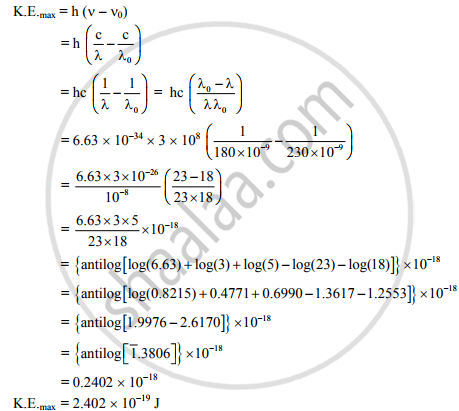
∴ The maximum kinetic energy of the ejected electron is 2.402 × 10⁻¹⁹ J.
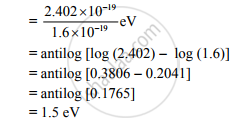
∴ The maximum kinetic energy of the ejected electron is 1.5 eV.
APPEARS IN
संबंधित प्रश्न
The threshold wavelength of silver is 3800Å. Calculate the maximum kinetic energy in eV of photoelectrons emitted, when ultraviolet light of wavelength 2600Å falls on it.
(Planck’s constant, h =6.63 x 1O-34J.s.,
Velocity of light in air, c = 3 x 10⁸ m / s)
The momentum of a photon of de Broglie wavelength 5000Å is _______.
[Planck’s constant = 6.63 x10⁻³⁴ J.s.]
State two important properties of photon which are used to write Einstein’s photoelectric equation.
A proton and a deuteron are accelerated through the same accelerating potential. Which one of the two has less momentum?
Give reasons to justify your answer.
Write its S.I. unit of (intensity of radiation)
Radiation of frequency 1015 Hz is incident on two photosensitive surface P and Q. There is no photoemission from surface P. Photoemission occurs from surface Q but photoelectrons have zero kinetic energy. Explain these observations and find the value of work function for surface Q.
The work function for a metal surface is 2.2eV. If the light of wavelength 5000Å is incident on the surface of the metal, find the threshold frequency and incident frequency. Will there be an emission of photoelectrons or not? (c = 3 x 10⁸ m/ s, 1eV = 1.6x10⁻¹⁹ J , h = 6.63 x 10⁻³⁴ J.s.)
According to Einstein’s model minimum energy needed for the electron to escape from a metal surface having work function ϕ0, the electron is emitted with maximum kinetic energy, Kmax = ______.
According to Einstein’s model, the threshold frequency for a metal having work function ϕ0 is given by _________.
Which of the following graphs correctly represents the variation of maximum kinetic energy (Ek) of photoelectrons with the frequency (𝜈) of the incident radiation?
A police van moving on a highway with a speed of 30 km/h fires a bullet at a thief's car speeding away in the same direction with a speed of 192 km/h. If the muzzle speed of the bullet is 150 m is, with what speed does the bullet hit the thief's car?
In an inelastic collision, which of the following does not remain conserved?
Radiations of two photon's energy, twice and ten times the work function of metal are incident on the metal surface successively. The ratio of maximum velocities of photoelectrons emitted in two cases is:
According to Einstein's photoelectric equation, the plot of the kinetic energy of the emitted photoelectrons from a metal Vs the frequency of the incident radiation gives as straight the whose slope:
A 200 W sodium street lamp emits yellow light of wavelength 0.6 µm. Assuming it to be 25% efficient in converting electrical energy to light, the number of photons of yellow light it emits per second is:
Dimensions of ‘resistance’ are same as (where h is Planck's constant and e is charge):
If the energy of photon corresponding to a wavelength of 6000 A° is 3.32 × 10⁻¹⁹ J, the photon energy for a wavelength of 4000 A° will be ______.
What will be wavelength of a photon of momentum 6.6 × 10⁻²⁴ kgms–1?
What is the momentum of photon of energy 3 mev in kg ms-1?
The emission of electron is possible
The wavelength of matter is independent of
The moment of a photon is given by
- Calculate the frequency of a photon of energy 6.5 × 10⁻¹⁹ J.
- Can this photon cause the emission of an electron from the surface of Cs of work function 2.14 eV? If yes, what will be the maximum kinetic energy of the photoelectron?
The graphs below show the variation of the stopping potential VS with the frequency (ν) of the incident radiations for two different photosensitive materials M1 and M2.

Express work function for M1 and M2 in terms of Planck’s constant(h) and Threshold frequency and charge of the electron (e).
If the values of stopping potential for M1 and M2 are V1 and V2 respectively then show that the slope of the lines equals to `(V_1-V_2)/(V_(01)-V_(02))` for a frequency,
ν > ν02 and also ν > ν01
